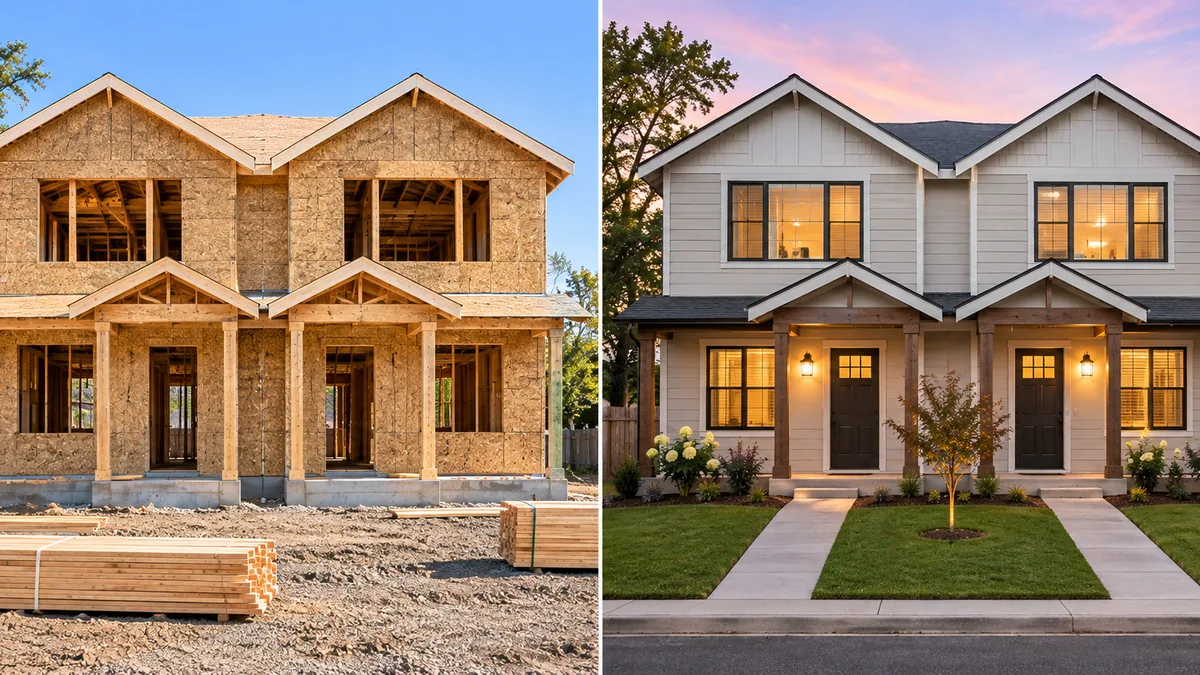
Building a duplex, triplex, or fourplex lets you put more rentable units on a single lot than a single-family home would. The units share land, a foundation, a roof, and much of the site work, so the cost per unit can be lower and the rental income per lot higher. Several states and cities have also changed their zoning to allow more two- to four-unit housing on lots that used to be limited to single-family homes.
But small multifamily isn't just a bigger house. Zoning, design, code, budget, and financing all work a little differently. This guide covers what changes and how investors finance these builds.
Confirm the lot allows the number of units you want before you design anything. Questions to answer:
Lots that already allow multiple units, or are close to it, generally carry less entitlement risk. See how to find and evaluate land and the permits and entitlements roadmap.
| Single-family | Duplex to fourplex | |
|---|---|---|
| Shared costs | Land, foundation, and roof serve one unit | Spread across multiple units |
| Kitchens and baths | One set | One set per unit |
| Fire and sound separation | Not needed | Rated walls or floors between units, as code requires |
| Utilities | One service | Often separate meters and panels per unit |
| Design | One layout | Mirrored or stacked layouts, separate entries |
The extra kitchens, baths, meters, and separation walls add cost, so the savings come mostly from shared land and structure. Price your budget from local new-construction costs. See construction cost per square foot.
In lending, two to four units is generally treated as residential, and five or more units as commercial. That line affects which loan programs are available, how the property is underwritten and appraised, and even which building code applies. Most investor construction loans for small builds focus on one to four units. If you're considering five or more, expect a different lending process.
Funds are released in draws as work is completed and inspected. See construction loan draws explained.
Appraisers typically look at comparable sales of similar small multifamily properties, and for rentals, the income the units can produce. In markets where new duplexes or fourplexes rarely sell, comparables can be thin, so build conservative value assumptions and gather rent comparables for each unit type early.
Deciding between holding and selling affects your design and finish choices. See build-to-rent vs. spec build.
A ground-up duplex or fourplex can put more income on a single lot, with shared land and structure keeping the cost per unit down. Confirm zoning and utilities first, budget for duplicated systems and fire separation, and stay at two to four units if you want residential-style construction financing. Plan your exit, whether hold, sell, or split, before you design.
Get Funded
Construction financing structured around your draw schedule — line up the build before you close.
Check Your EligibilityFunding in as little as 7 days · No impact to your credit score
Yes. Many investor construction lenders finance 2–4 unit builds. Lenders review the plans, budget, builder, zoning, and projected value or rents, and terms vary by lender.
Often per unit, because the units share land, a foundation, a roof, and some site work. But a duplex adds costs a single home doesn't have, like fire separation between units and duplicate kitchens, baths, and utility meters.
Five or more units is generally treated as commercial real estate, with different lending programs, underwriting, and building code requirements. Two to four units is usually treated as residential.
Once it's finished and rented, investors commonly refinance into long-term financing such as a DSCR loan, which looks at the property's rental income.