Ground-Up Construction
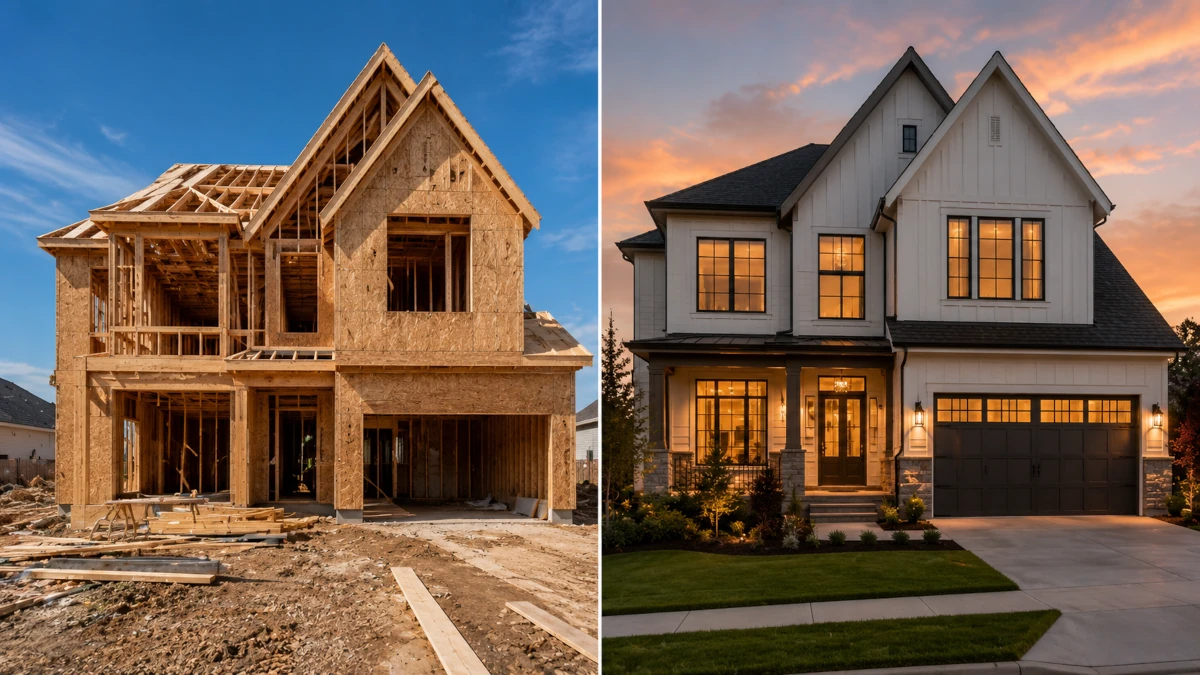
Construction-to-Permanent Loans: How to Convert Your Build Loan to Long-Term Financing
A construction-to-permanent loan (commonly called a C2P or "one-time close") is a single financing instrument that funds construction during the build period, then automatically converts to a permanent mortgage when construction completes. Instead of taking out a short-term construction loan and then refinancing into a long-term loan after certificate of occupancy, you do both legs in one closing — with one set of closing costs, one underwriting cycle, and one rate lock.
The structure has been a staple of owner-occupied custom home financing for decades. Over the last several years it has become increasingly available for investor builds, particularly through DSCR-style perm products and a handful of specialty lenders.
Two products often get described as "construction-to-permanent" but work very differently in practice.
One closing, one set of fees, one note. The loan starts as interest-only on drawn balances during construction, then automatically modifies to a fully amortizing permanent loan at completion. Rate is typically locked at the front, sometimes with a float-down option if rates drop during the build.
Advantages: One set of closing costs (saves $5,000-15,000), one underwriting cycle, no risk of failing to qualify for a refinance later, no risk of rates moving against you mid-build.
Disadvantages: Smaller pool of lenders offers true single-close on investor builds. Rate locked early may be higher than a market rate at completion. Underwriting is more rigorous because the lender is approving the perm loan before the property exists.
A short-term construction loan funds the build, then a separate permanent loan refinances it at completion. This is what most investors actually do, even when they call it "construction-to-permanent." It is two closings, two sets of closing costs, two underwriting events.
Advantages: Wider lender selection on both legs. Flexibility to shop the perm refinance based on market rates at completion rather than locking early. Can change strategy mid-build (sell instead of hold, switch from LTR to STR, etc.).
Disadvantages: Pay closing costs twice. Re-qualify for the perm at a moment when rates may be higher or your DSCR may have shifted. Risk of being unable to refinance if appraisal comes in low or program guidelines tighten.
For investors using a true single-close C2P, the loan moves through three phases:
Single-close C2P loans handle the rate question in one of three ways:
For an investor build, the locked-with-float-down option is usually the right answer when available. You get the worst-case protection of a hard lock plus the upside of a market drop. The cost is typically 25-50 basis points on the rate or 0.5-1.0 points at closing.
The biggest practical difference between owner-occupied C2P and investor C2P is how the perm loan qualifies.
On an owner-occupied build, the perm loan typically qualifies on the borrower's W-2 income, debt-to-income ratio, and credit score — same as any conventional purchase mortgage.
On an investor C2P, the perm loan qualifies on the property's projected rental income via a DSCR calculation. The lender uses an as-completed appraisal that includes a rent estimate (Form 1007 or equivalent), then runs DSCR against the perm loan's PITIA. DSCR of 1.0+ typically qualifies; 1.20+ is preferred.
This matters because the rent estimate is being made on a property that does not yet exist. Conservative appraisers — and most rent appraisers err conservative on new construction — can come in below your pro-forma. Build a 10-15% cushion into your DSCR projection so a soft rent estimate does not derail the perm conversion.
An investor building a $500,000 single-family rental on a lot they own free and clear:
Construction phase interest costs (assuming 9-month build, average 60% of loan drawn): ~$17,100. At conversion, the loan modifies to permanent terms with no second closing. Total closing costs on the C2P were ~$11,000 — versus an estimated $18,000-22,000 for two separate closings.
Single-close C2P typically wins when:
Two-close construction + take-out refi typically wins when:
C2P underwriting is more rigorous than a standalone construction loan because the lender is committing to the perm loan before the property exists. Expect:
This rigor is worth it for the right project. It is also why some investors prefer to take a standalone construction loan, build the property, then refinance into a separate DSCR perm — they trade higher closing costs for less front-end paperwork and more flexibility to change direction mid-build.
Construction-to-permanent loans solve a real problem for buy-and-hold investor builders: the conversion-risk gap between completing construction and qualifying for permanent financing. The single-close version saves real money in fees and removes the refinance-qualification risk; the tradeoff is a smaller lender pool, more upfront underwriting, and a rate locked before the property exists. For investors with a clear hold strategy and a build that pencils with cushion, single-close C2P is often the best-shaped product available. For investors with optionality on the back end, two-close construction-plus-refi is the more flexible path.
Get Funded
Construction financing structured around your draw schedule — line up the build before you close.
Check Your EligibilityFunding in as little as 48 hours · No impact to your credit score