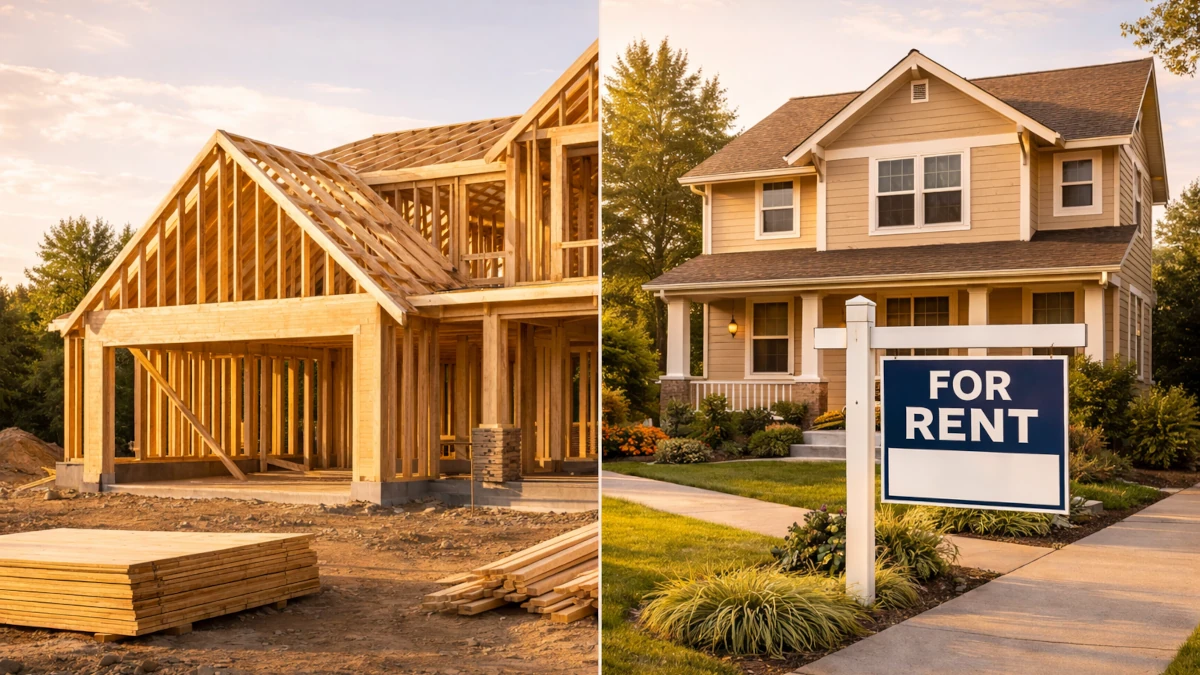
Every real estate investor eventually confronts the build vs. buy question. Buying an existing property is faster, simpler, and more familiar. Building from scratch offers control, customization, and — in the right markets — a meaningful cost basis advantage. Neither strategy is universally superior. The right answer depends on your market conditions, timeline, available capital, and operational capacity. Here is a complete, honest comparison.
| Factor | Build (Ground-Up) | Buy (Existing) |
|---|---|---|
| Timeline to first rent check | 9–18 months (build + lease-up) | 30–60 days after closing |
| Cost certainty | Lower — subject to construction variance | Higher — purchase price is known at signing |
| Control over the product | Complete — layout, finishes, systems | Limited — work with what exists or renovate |
| Deferred maintenance risk | None — everything starts new | Present — unknown issues are common |
| Financing complexity | Higher — construction loan, then permanent | Lower — single purchase loan at closing |
| Competition at acquisition | Lower — you’re not bidding on existing inventory | Higher — competitive offers are common in most markets |
When you build, every system and surface starts at zero. No aging HVAC approaching replacement, no galvanized plumbing, no roof with five years left. For a buy-and-hold investor, this dramatically reduces capital expenditure exposure in the first 10–15 years of ownership — exactly when you want cash flow compounding rather than being absorbed by repairs.
Existing properties were typically built for owner-occupants, not tenants. Building from scratch lets you design with an investor’s mindset: durable LVP flooring instead of carpet, practical bedroom distribution, low-maintenance landscaping, and finishes that photograph well for listings. These decisions compound into lower turnover costs and faster lease-up over the life of the investment.
In markets where renovated existing inventory trades above replacement cost, building can produce a superior cost basis. If comparable finished properties are selling at $380,000 but you can build one for $310,000 all-in, you have $70,000 of instant equity at certificate of occupancy — and a DSCR refinance that reflects the higher market value.
Ground-up builds pair naturally with the BRRRR strategy. Build the property using a construction loan, stabilize it with a tenant, then refinance into a long-term DSCR loan based on the completed value. Done correctly, the refinance returns most or all of your initial capital to deploy into the next deal.
The most significant advantage of buying existing is timing. A standard purchase closes in 30–45 days. A ground-up build takes 9–18 months before the first rent check. During that entire build period you are carrying construction loan interest with no offsetting income. For investors who need current cash flow, buying is simply faster.
Construction projects carry risks that purchase transactions don’t: contractor performance issues, permit delays, material cost increases, weather, and scope surprises. Even a well-run build can encounter setbacks that push timelines and test budgets. Buying an existing property — even one needing cosmetic renovation — involves a shorter, more predictable path to stabilized income.
A DSCR loan on an existing rental property involves one appraisal, one closing, and a clean underwriting process. A construction loan involves plans review, budget approval, draw schedules, inspections, and a conversion or second closing at completion. More moving parts means more opportunities for delay — and more lender scrutiny throughout the process.
A growing number of experienced investors are building small portfolios of purpose-built rentals rather than assembling them through acquisitions. This build-to-rent approach — constructing 2–10 SFRs or a small multifamily and holding them long-term — is gaining traction in Sun Belt and Midwest markets where land remains available and construction costs sit below stabilized property values. It requires more infrastructure (GC relationships, permitting experience, construction capital) but can produce a cleaner, more uniform portfolio than accumulating existing properties of varying age and condition over time.
For more on how to finance a ground-up build, see our construction loans guide and how construction loan draws work.
BrightPath offers ground-up construction loans and DSCR loans for completed rentals. Get the right product for your exit strategy.
Explore Loan Programs ↗