Ground-Up Construction
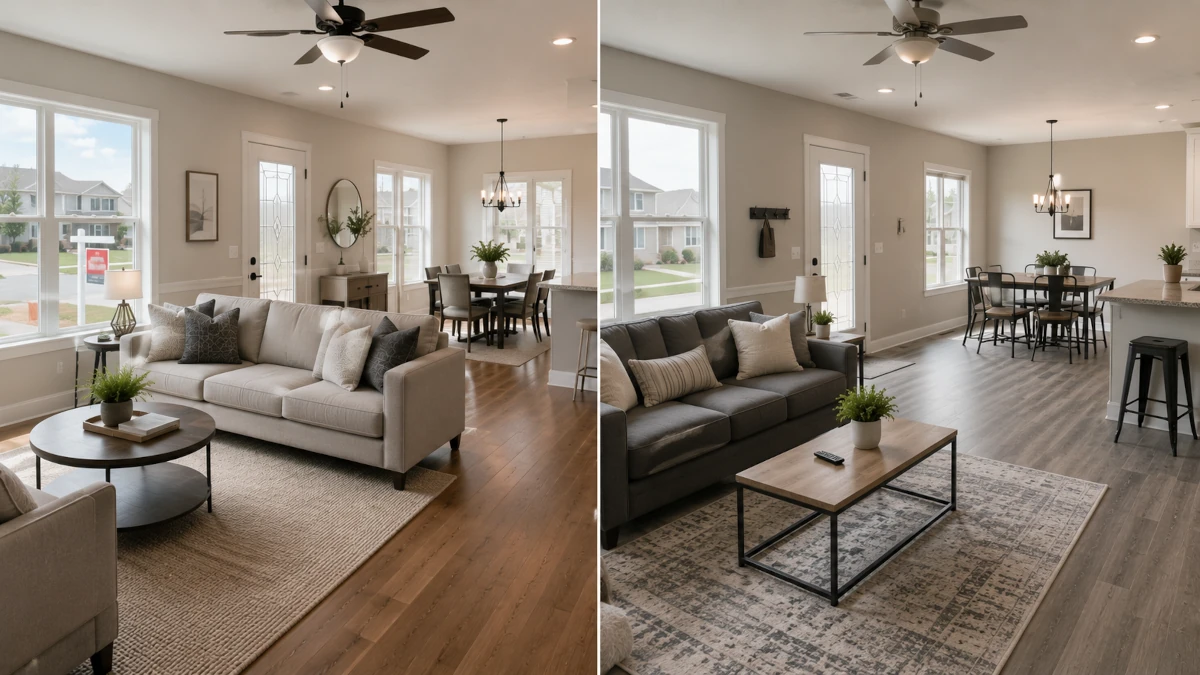
Build-to-Rent vs. Spec Build: Two Construction Strategies, Two Different Exit Math
You pull a building permit, you build a single-family home, you hit certificate of occupancy. Now what? Two paths sit in front of you. The first — spec build — sells the property to an owner-occupant on the open market and books the construction profit. The second — build-to-rent (BTR) — keeps the property, finances it long-term with a DSCR loan, and converts it to a cash-flowing rental.
The decision between the two looks like a personal preference question. It's actually an underwriting question — the math is different, the financing is different, and the design decisions during construction are different. Choosing wrong, or worse, building one product and trying to pivot to the other exit, is a fast way to compress margin to zero. This guide walks through the actual differences.
The two strategies make money in fundamentally different ways:
| Spec Build | Build-to-Rent | |
|---|---|---|
| Profit source | Sale price minus all costs | Equity capture at refi + long-term cash flow + appreciation |
| Time to liquidity | 0–6 months post-CO (sale) | Years to decades (held) |
| Tax treatment | Ordinary income (dealer) | Capital gains + depreciation shelter |
| Repeatable scale lever | Capital velocity (recycle equity) | Portfolio compounding (rents + appreciation) |
| Market exposure | Resale market at moment of completion | Rental demand + interest rate cycle |
Spec builders monetize the gap between all-in cost and retail price once, per project. Build-to-rent investors don't monetize that gap immediately — they capture it as equity at refinance, then earn yield on it over years through rent and appreciation.
Both strategies start the same way — a ground-up construction loan covers the build. The divergence happens at certificate of occupancy.
Spec build exit: The construction loan is repaid by the sale proceeds. The buyer takes a conventional mortgage (or pays cash). Your construction loan is gone; your profit is realized; you redeploy capital into the next build.
Build-to-rent exit: The construction loan is refinanced into a long-term loan you hold. The two common takeouts:
Either way, the refinance amount is constrained by the lower of: LTV cap × appraised value, or DSCR-allowable amount based on market rent. The latter is often the binding constraint in higher-priced markets where rents lag price growth.
This is the part most first-time builders miss. The same square footage built two different ways serves two different exits.
| Decision | Spec Build | Build-to-Rent |
|---|---|---|
| Finish level | Higher — what the local market expects at price point | Durable, mid-tier — LVP, quartz, MDF trim |
| Floor plan | Open concept, statement spaces | Bedroom count over square footage |
| Bathrooms | One per bedroom is desirable | Two full bathrooms = rental sweet spot for SFR |
| Garage | Two-car standard in most markets | One-car acceptable in dense urban markets |
| Yard / landscape | Curb appeal investment | Low-maintenance hardscape |
| Appliances | Stainless, branded | Tenant-grade, replaceable |
| Flooring | Hardwood in living areas | LVP throughout |
The cost delta between spec finishes and BTR finishes typically runs $15–$40/sqft. On a 2,000 sqft home, that's $30K–$80K of capital that either becomes resale gain (spec) or stays in your pocket as captured margin (BTR). Both are valid — but a BTR-finished property in a spec-finish neighborhood will appraise low and sell slow; a spec-finished property held as a rental ties up capital in finishes that don't drive rent.
| Market Characteristic | Favors Spec | Favors BTR |
|---|---|---|
| Resale demand | Strong, low DOM | Soft or seasonal |
| Rent-to-price ratio | Low (under 0.6%) | High (above 0.8%) |
| Appreciation history | Strong recent gains | Stable, modest appreciation |
| Construction cost relative to comps | Cost well below comps | Cost roughly at comps |
| Rental population | Lower | Higher (workforce, military, university) |
| Investor competition | Less crowded | More crowded with iBuyers, BTR funds |
The high-level pattern: spec builds work best where resale value exceeds construction cost by a wide enough margin to absorb a holding period if the market softens. BTR works best where rental demand is structurally strong and the long-term hold compounds — even if the immediate sale margin would be thin.
Single-family build, 2,000 sqft, mid-tier suburban market.
| Land cost | $140,000 |
| Hard construction cost | $340,000 |
| Soft costs (permits, design, financing) | $60,000 |
| All-in cost | $540,000 |
Spec exit: Sell at $675,000 retail. Selling costs (commission + closing): $48,000. Net profit: $87,000. Pre-tax IRR depends on project length but typically 15–30%.
BTR exit: Property appraises at $660,000 (slightly less than retail because tenant-grade finishes). Refi at 75% LTV = $495,000 long-term loan. Capital remaining in deal: $45,000. Market rent $3,800/mo, all-in operating expenses $1,200/mo, mortgage PITI $3,150/mo. Monthly cash flow: −$550/mo initially, before rent growth.
The spec exit returns $87K cash. The BTR exit returns $0 cash and a property that doesn't quite cash-flow at acquisition — but with $215K of captured equity, a depreciation shelter, and decades of rent growth ahead. Which one wins depends entirely on what you do next with the spec proceeds and how long you hold the BTR. Neither is universally better. The bad answer is to choose between them without modeling both.
Sophisticated builders sometimes blend the two strategies within a single project:
Build-to-rent and spec build are not interchangeable strategies — they have different exit math, different financing structures, and different design decisions during construction. The right strategy is the one your market supports and your capital plan requires. Spec velocity recycles capital fast; BTR compounds equity slowly. Both work; building one product hoping to pivot to the other exit is what doesn't work. For the construction loan that bridges either exit, see our draw schedule guide.
Get Funded
Construction financing structured around your draw schedule — line up the build before you close.
Check Your EligibilityFunding in as little as 48 hours · No impact to your credit score
Build-to-rent is a strategy where the investor constructs a property specifically to hold as a long-term rental rather than to sell. At certificate of occupancy, the construction loan is refinanced into a long-term DSCR or conventional mortgage based on the property's rental income, and the captured equity (appraised value minus all-in cost) stays in the deal as long-term equity. It contrasts with spec building, where the property is sold immediately at retail.
The answer depends on your market and your capital plan. Build-to-rent makes sense in markets with strong rental demand, healthy rent-to-price ratios, and stable appreciation. Spec building makes sense in markets with strong resale demand and a wide gap between construction cost and comparable retail prices. The most common mistake is building one product (spec or BTR finishes) and then trying to pivot exits — finishes don't translate well between markets.
BTR uses durable, mid-tier finishes optimized for tenant turnover and replacement cost — LVP flooring throughout, quartz counters, tenant-grade appliances, MDF trim. Spec build uses higher-tier finishes matched to local market expectations at the target price point — often hardwood in living areas, branded stainless appliances, more substantial trim and millwork. The cost delta is typically $15–$40 per square foot, which becomes either resale gain (spec) or captured margin (BTR).
Mostly yes — a ground-up construction loan funds the build regardless of exit. The divergence happens at certificate of occupancy. Spec builds pay off the construction loan with sale proceeds. Build-to-rent refinances the construction loan into a long-term DSCR or conventional mortgage. Construction-to-permanent (C2P) loans pre-arrange this conversion at origination, which can save time and closing costs for BTR investors.