What Is Ground-Up Construction Investing
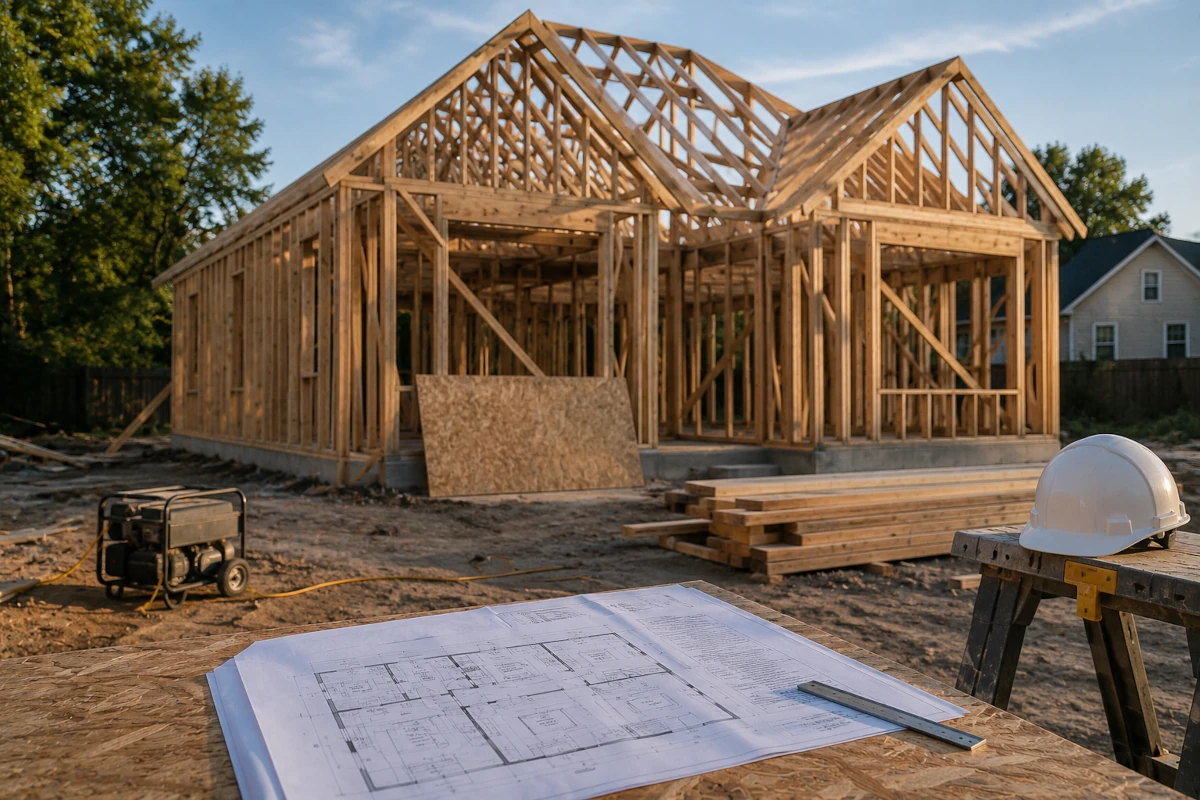
Ground-up construction is the real estate strategy of building new investment property from raw land or a vacant lot — rather than buying and renovating an existing structure. You acquire a buildable lot, design and permit the property, hire a contractor to construct it, and then either sell the finished building (spec building) or hold it as a rental (build-to-rent, often shortened to BTR).
Unlike fix-and-flip, where you’re improving an existing house, ground-up construction means designing the property yourself — choosing the floorplan, finish level, and target buyer or tenant from a blank lot. That control is a major advantage when you read the market correctly and a major liability when you don’t.
The strategy splits into two distinct exit paths that share an identical build phase:
Spec building: Build the property, sell to an end buyer at completion. Profit comes from the spread between After-Built Value (ABV) and total project cost minus selling costs. Capital recycles after sale. Taxed as ordinary income.
Build-to-rent (BTR): Build the property, place a tenant, refinance into a long-term loan, hold for rental income and appreciation. Capital recycles partially through the refinance. Long-term tax treatment with depreciation and 1031 options.
Both paths use the same construction phase. The decision about which exit fits comes down to market dynamics, your capital position, your tax preferences, and increasingly, your risk tolerance for a 14–20 month total cycle time.
Why Build From the Ground Up vs. Buying Existing
Most real estate investors never seriously consider ground-up construction because the timeline is intimidating and the capital requirement is meaningfully higher than for acquisitions. But for investors who can manage both, the strategic advantages are real.
What ground-up rewards
Forced equity through construction. Just as a fix-and-flip investor manufactures equity through renovation, a ground-up investor manufactures equity through new construction. The gap between your all-in cost (land + hard costs + soft costs + carrying) and the After-Built Value is your forced equity. In most markets, ground-up projects produce 15–25% spread — often higher than what’s available on existing-stock flips because there’s far less competition in the lot-acquisition space than the distressed-home space.
Modern product that commands premiums. A 2026 new build with current floorplans, energy efficiency, and modern materials sells or rents at a premium to a comparable 1985 ranch. The premium is real and persistent. Buyers and tenants both pay measurably more for new construction at the same square footage.
No rehab surprises. When you build new, you don’t open walls to discover knob-and-tube wiring or failed plumbing. The cost variables on a new build are real, but they’re knowable up front. Fix-and-flippers regularly blow rehab budgets by 30–50% from things they couldn’t see at purchase; new-build budget overruns tend to come from change orders and material price shifts, not hidden conditions. That’s a smaller and more controllable risk surface.
Strategic flexibility on exit. Spec sales are taxed as ordinary income. BTR projects qualify for depreciation, 1031 exchanges, and long-term capital gains treatment when eventually sold. The decision about which path your project takes can sometimes be made late in the build, giving you tax-strategy flexibility that no other real estate strategy offers.
What ground-up punishes
Longer timeline. A typical single-family build runs 9–12 months from land closing to certificate of occupancy. Add 3–6 months for permitting in slower jurisdictions. Add lease-up time for BTR exit. Total cycle time of 14–20 months is normal — versus 4–6 months for a flip. That’s a long time for capital to be deployed without revenue.
Higher capital requirement. Construction loans typically lend 70–80% of total project cost (not 85–90% of acquisition like some bridge loans). You’re putting 20–30% down on the full project. On a $400,000 build that’s $80,000–$120,000 of cash to start — and the carrying costs during the build hit your cash position before any revenue comes in.
Operational complexity. Ground-up requires managing land acquisition, plan approval, permit processes, builder selection, draw schedules, change orders, and timeline. Investors who hate operational detail struggle here. A flip is operationally simpler than a ground-up build, and a turnkey rental is dramatically simpler than both.
Market timing risk. The 14-month build cycle exposes you to market shifts. If you start construction in a strong market and finish in a softening market, your projected ABV may not materialize. Buy-and-hold rentals are largely immune to this timing risk; ground-up isn’t.
Spec Building vs. Build-to-Rent: Which Strategy Fits
Spec and BTR share the construction phase but diverge completely at completion. Choose the right exit before you start the project — the design decisions, finish-level choices, and even floorplan are different between the two.
Spec building
You build to sell. The exit is a listing and sale to an end buyer at completion. Profit comes from the spread between After-Built Value and total cost minus selling costs.
When spec works: Markets with strong owner-occupant demand for new construction, sustained absorption rates, and pricing that supports profitable spread after 6–7% selling costs. Spec is most viable in suburbs and growing secondary cities where end buyers are paying meaningful premiums for new product.
Design implications: Higher finish level than BTR (granite or quartz, hardwood floors, premium fixtures), open floor plans that show well in marketing photos, curb appeal that creates instant attraction at the listing.
Capital recycling: Faster than BTR. After sale, full capital comes back minus the profit (which is taxable as ordinary income or self-employment income).
Best for: Investors who want to build wealth through high-velocity profit cycles, or who don’t have the cash position to carry properties through a refinance seasoning period.
Build-to-rent (BTR)
You build to hold. The exit is a refinance into a long-term DSCR or conventional loan, with the property held as a rental.
When BTR works: Markets with strong rental demand for new construction, rents that support DSCR-qualifying refinance terms, and locations where appreciation will continue compounding over a long hold. BTR is most viable in growing metros with rising rents and constrained rental supply.
Design implications: Durable finishes (LVP rather than hardwood, quartz rather than premium granite), simpler floor plans optimized for tenant turnover, lower maintenance materials, energy efficiency for lower operating costs.
Capital recycling: Slower than spec. You recover via refinance (typically 75% of ABV), so 20–25% of equity stays in the property. But you keep an appreciating, cash-flowing asset and benefit from depreciation shelter and eventual 1031 exchange options.
Best for: Investors building a long-term rental portfolio who want modern product (lower maintenance, higher rent quality), or investors with strong cash positions who can hold properties indefinitely.
The flexible approach
A growing segment of ground-up investors keeps the exit decision flexible — they design and build with both paths viable, then choose based on market conditions at completion. This works when the local market supports both options and you have the cash position to either exit. The downside is that you may build with compromises (finishes that work for both spec sale and rental hold but excel at neither). The upside is real optionality on exit.
How to Analyze a Ground-Up Deal
The ground-up underwriting framework is more complex than for acquisition deals because you’re modeling costs that won’t be fully known until the build is underway. The discipline is to be conservative on every estimate and stack contingencies for the variables you can’t fully control.
The two core formulas, depending on your intended exit:
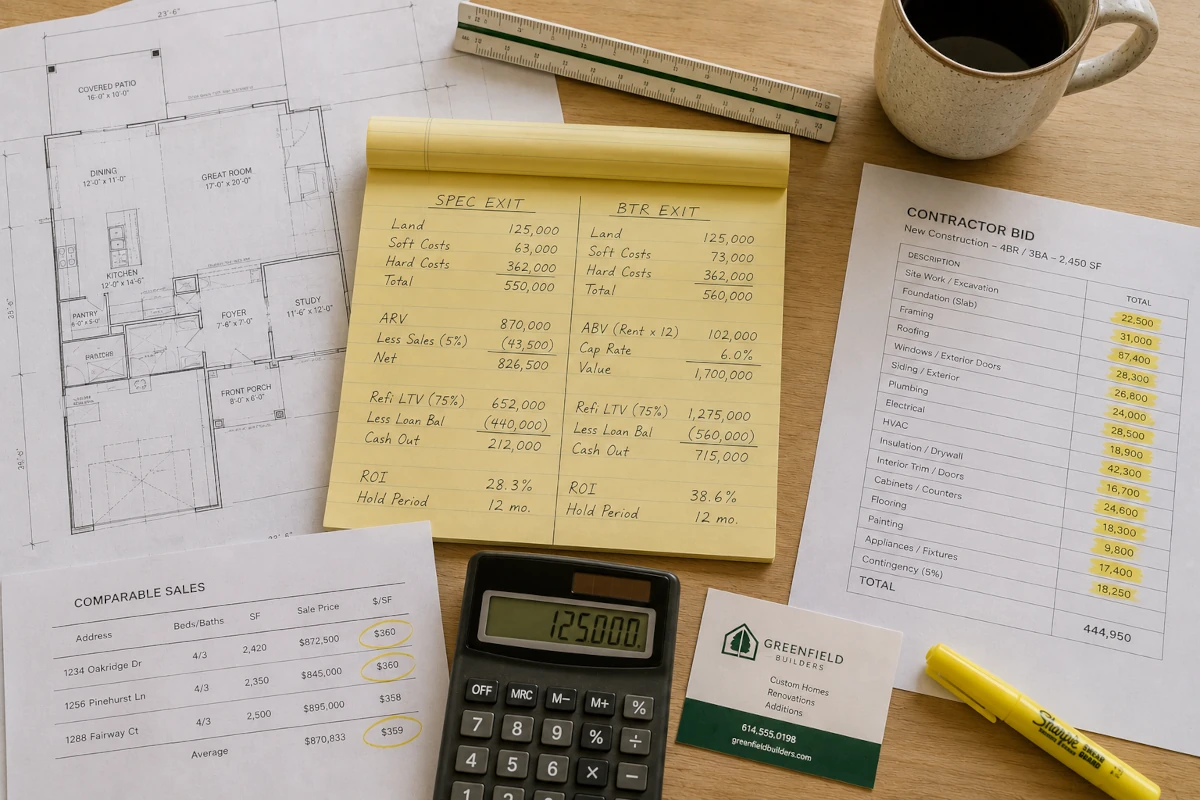
Worked example. You’re evaluating a buildable lot in a growing suburb. Closed comps support an After-Built Value of $450,000 for a 3-bedroom, 2.5-bath, 2,200-square-foot new construction home with finishes matching local new-build standards. The lot is listed at $50,000.
Start with total project cost:
| Land/Lot Acquisition | $50,000 |
| Soft Costs (plans, permits, engineering, surveys, impact fees) | $25,000 |
| Hard Costs (construction, 2,200 sqft × $115/sqft) | $253,000 |
| Carrying Costs (12 months: loan interest, taxes, insurance) | $15,000 |
| Contingency Reserve (10% of hard + soft) | $28,000 |
| Total Project Cost | $371,000 |
Now model the spec exit:
| Sale Price (ABV) | $450,000 |
| − Selling Costs (7% of ABV) | −$31,500 |
| − Total Project Cost | −$371,000 |
| Net Profit (Spec Exit) | $47,500 |
| Profit as % of ABV | 10.6% |
At 10.6% of ABV, this is on the marginal end of spec viability. A more attractive spec deal would target 15%+ of ABV in net profit. The lot at $50,000 is the variable that’s squeezing the math — if you could acquire the same lot at $35,000, profit improves to ~$62,500 (13.9% of ABV).
Now model the BTR exit on the same project, assuming completed property rents for $2,800/month:
| After-Built Value | $450,000 |
| DSCR Cash-Out Refi at 75% LTV | $337,500 |
| − Refi Closing Costs (est.) | −$5,000 |
| Net Cash from Refi | $332,500 |
| Less Total Project Cost | −$371,000 |
| Capital Left in Deal | $38,500 |
| Equity Position Post-Refi ($450k − $337.5k) | $112,500 |
The BTR exit leaves $38,500 of capital in the deal but produces $112,500 of equity, plus a long-term rental asset generating monthly cash flow. Verify the cash flow supports the refi:
| Monthly Rent | $2,800 |
| − Operating Expenses (vacancy, mgmt, maintenance, CapEx ~25%) | −$700 |
| Monthly NOI | $2,100 |
| − Monthly Debt Service (PITIA on $337,500) | −$2,250 |
| Monthly Cash Flow | −$150 |
| DSCR Ratio (NOI ÷ Debt Service) | 0.93x |
This BTR underwrites poorly at current rates — the DSCR of 0.93x won’t qualify for most refinance lenders (who typically require 1.0–1.10x minimum), and the property would cash flow negative on the refinance. In this scenario, spec is the right exit unless rents or rates change before completion.
The bigger lesson: always run both exits during underwriting, even if you’ve mentally committed to one. The math has a way of revealing which exit the deal actually supports.
If you want to compare ground-up deal math against existing-property strategies, our fix-and-flip property guide covers acquisition-side flips and our rental property guide covers the buy-and-hold side. The ground-up construction loans guide covers the financing mechanics in full.
How to Finance Ground-Up Construction
Construction financing is fundamentally different from acquisition financing. The loan funds in stages (called “draws”) tied to construction milestones, rather than being disbursed at closing. Interest accrues only on amounts already drawn. And — critically — most construction loans either convert to permanent financing at completion or require a separate refinance.
Construction loans
The standard ground-up financing product. Construction lenders fund the project based on a percentage of total project cost (LTC) or appraised After-Built Value (LTV), with most lenders using whichever produces the smaller loan amount. Typical terms:
LTC/LTV: 70–80% of total project cost or 70–75% of After-Built Value, whichever is lower.
Interest: 9–12% in current rate environment, with 1–3 points origination. Higher than acquisition loans because construction adds completion risk.
Term: 12–24 months interest-only during construction, with conversion or refinance at completion.
Draw schedule: Funds released in stages tied to construction milestones — typically foundation, framing, mechanicals/rough-in, drywall, finishes, certificate of occupancy. Lender inspects before each draw. You front the costs and get reimbursed.
Interest reserve: Many construction loans include an interest reserve — a portion of the loan amount that covers interest payments during the build. This prevents you from having to make interest payments out of pocket during the build, but you pay interest on the interest reserve itself.
For full mechanics on construction lending including draw schedules, conversion options, and rate structures, see our ground-up construction loans guide →
Permanent financing at completion (BTR exit)
For BTR projects, the construction loan converts to or is refinanced into a permanent long-term loan. The two common products:
DSCR cash-out refinance. Qualifies the loan on rental income, not personal income. 75% LTV typical, 30-year amortization. The standard BTR exit. See the DSCR loans guide for full mechanics.
Conventional cash-out refinance. Available to investors with strong personal income capacity. Lower rates than DSCR but harder to qualify and won’t scale across multiple properties past your DTI ceiling.
Cash construction
Always an option, and the cleanest financing structure. Cash construction eliminates loan interest during the build, removes draw-schedule timing risk, and gives you maximum negotiating leverage on land. The downside is that significant capital is tied up for 14+ months — capital that could be funding multiple acquisition deals in the same time period.
Land, Permits, and Pre-Construction
The pre-construction phase is where most new ground-up investors underestimate the work. Months of effort and significant cost happen before a shovel hits the dirt. Mishandling this phase is the most common reason ground-up projects stall or fail.
Lot selection
What makes a lot buildable for investment-grade construction: zoning that matches your intended use, utility access (water, sewer or septic, electric, gas where applicable), no environmental issues (wetlands, contaminated soil, protected species), no flood zone restrictions that complicate insurance and buyer/tenant financing, manageable topography (steep slopes add significant cost), setback requirements that allow your intended footprint, and proximity to comparable closed sales that establish a defensible ABV.
Lots that look like deals at first glance often aren’t. Cheap lots are usually cheap for a reason — bad zoning, restrictive HOAs, infrastructure problems, or a market that simply won’t support new construction at that location. The right lot is rarely the cheapest one.
Permits, plans, and entitlement
Before you can build, you need: architectural plans (typically $5,000–$15,000 for a single-family home), structural engineering (often required by code), a site plan, a building permit from the local jurisdiction, and depending on location, additional approvals from utilities, HOAs, environmental agencies, and zoning boards. Total timeline ranges from 30 days in fast jurisdictions to 6+ months in slow ones.
Permit fees and impact fees vary wildly by jurisdiction. A build that costs $5,000 in permits in a fast Texas suburb might cost $35,000 in a slow California municipality. Research permit costs and timelines for your specific jurisdiction before committing to a lot.
Builder selection
The builder or general contractor you hire is the single most important decision in the ground-up process. A great builder delivers on time and on budget, manages subcontractors competently, and catches problems before they become expensive. A bad builder destroys margin through delays, change orders, and rework.
What to vet: license and insurance current and valid, references from completed projects (not just current ones), financial stability (bankrupt builders abandon projects mid-build), capacity (a builder with too many concurrent projects gives your job to junior crews), and contract structure (fixed-price contracts shift risk to the builder; cost-plus contracts shift it to you).
The contract
The construction contract should be written, not verbal, and should include: scope of work with detailed specifications, fixed price or clearly-defined cost-plus structure, payment schedule tied to milestones (never pay the whole amount upfront, and never let payments get ahead of completed work), change order process in writing, completion date with liquidated damages for delays, warranty terms post-completion, and termination provisions if things go badly. An attorney review of the contract is worth $500–$1,500 in legal fees on a project this large.
Common Ground-Up Mistakes
The pattern of failed ground-up projects is consistent. The expensive six:
1. Underestimating soft costs
The most common new-investor mistake. Hard costs (the actual construction) get budgeted carefully because contractors give explicit bids. Soft costs — architect, structural engineer, surveyor, permits, impact fees, environmental studies, utility connections, builder’s risk insurance — often add up to 8–12% of project cost and routinely catch new builders by surprise. Budget soft costs explicitly and conservatively.
2. Building the wrong product for the market
A 4-bedroom luxury home in a starter-home neighborhood won’t command the premium pricing the build cost requires. A 2-bedroom cottage in a family-oriented suburb won’t maximize ABV from the lot. Ground-up gives you more product flexibility than any other real estate strategy — which means more ways to choose wrong. Match product to comparable closed sales in the immediate area before committing to plans.
3. Choosing the wrong builder
The cheapest bid is almost never the right choice. The right builder is the one whose history, financial stability, capacity, and references hold up under serious scrutiny. Paying 10% more for a builder you trust is dramatically cheaper than paying 0% more for a builder who abandons your project at 80% completion.
4. Ignoring infrastructure timelines
Utility connections (especially sewer or septic), road approvals, and impact-fee processing can add months. These are sequence-blocking issues — you can’t close out construction without them. Schedule them early in the project, not as completion items.
5. Assuming permits and entitlement will be easy
Zoning rules, setback requirements, HOA restrictions, and neighborhood-specific overlays can prevent you from building what you want even on a lot you own. Verify entitlement before closing on the lot — not after. Permit appeals and zoning variances can take months and may fail entirely.
6. Market shift during the build
Starting construction in a strong market and finishing in a weakening one is a real risk on a 14–20 month cycle. Mitigation: don’t over-commit to spec-only exits when BTR is also viable. Build flexibility into the exit decision. If markets shift, you have an alternative path that doesn’t require selling into a weak environment.
Frequently Asked Questions
On a typical $350,000 single-family build with 75% LTC construction financing, plan on $90,000–$130,000 in cash to close and carry: 25% down on total project cost, the early soft costs before the loan funds, points and closing costs, and reserves for change orders during the build. Cash buyers obviously need significantly more.
14–20 months from land closing to project exit is the typical range: 3–6 months for permits and plans, 9–12 months for construction, and 1–3 months for sale (spec) or lease-up plus refinance seasoning (BTR). Faster jurisdictions and simpler builds can compress this; complex projects or slow municipalities can extend it.
Different metrics. Spec produces faster near-term cash and ordinary-income tax treatment. BTR produces slower capital recovery but a long-term appreciating asset with depreciation shelter and eventual 1031 exchange options. In strong appreciation markets, BTR wins long-term. In faster-cycling markets, spec wins. Many ground-up investors do both depending on the specific project and local market conditions.
No. Most ground-up investors are not licensed contractors. You hire a licensed general contractor (GC) to manage the construction. Some investors do act as their own GC to save the GC fee (typically 10–15% of construction cost), but this requires construction expertise, time availability, and acceptance of significantly more risk. Most jurisdictions require at minimum that you pull permits with a licensed contractor on file. Check local rules before assuming you can self-manage.
Yes, with selectivity. Higher construction rates have compressed margins, which means lot acquisition pricing and product-market fit matter more than they did in cheaper-money years. Markets with strong demand for new construction, available buildable lots, and rents (for BTR) or sale comps (for spec) that justify the build still produce viable projects. Markets where lot prices have inflated faster than ABV growth don’t.
Builder execution. A great builder delivers on budget and on time and the project profits as modeled. A bad builder destroys margin through delays, change orders, lien filings, and in worst cases, abandonment of partial projects. Vet builders more carefully than you vet any other decision in the project — the lot, the financing, even the market matter less than the builder you choose.
Get Funded
Finance Your Ground-Up Build
Construction financing structured around your draw schedule — line up the build before you close.
Check Your EligibilityFunding in as little as 21 days · No impact to your credit score