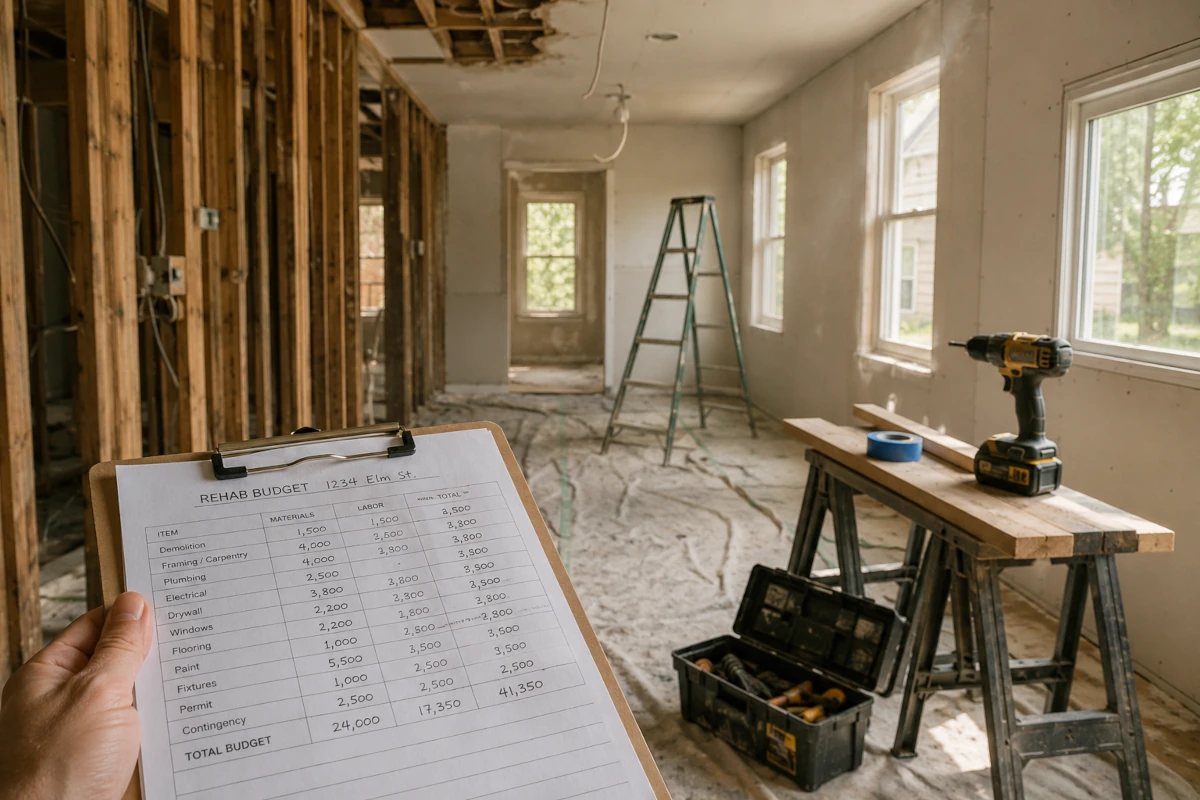
Why Fix and Flip Property
Fix and flip is the fastest way most investors can turn capital into profit in real estate. A well-bought flip can return 15–20% on the all-in cost in 4–6 months, then recycle the same capital into the next deal. Over a year, that’s 2–3 flips per dollar of equity — a velocity buy-and-hold rental investing can’t match.
But it’s also the strategy that washes more investors out of the business than any other. The pattern is consistent: a first flip that looks great on paper turns into a holding-cost nightmare, the second flip never happens, and the “easy profit” thesis collapses. Before you decide whether to fix and flip property, you should be honest about what the strategy actually rewards and punishes.
What flipping rewards
Forced equity, not market appreciation. Unlike buy-and-hold rentals where most of your return comes from appreciation over years, a flip’s profit comes from the gap between the cost basis (purchase + rehab) and the After Repair Value (ARV). You’re manufacturing equity through renovation, not waiting for the market to deliver it.
Capital velocity. The same $100,000 of equity that buys one rental property and sits there can fund 2–3 flips per year. If each flip nets $30,000–$50,000, you’re generating $60,000–$150,000 in annual profit from the same capital base — without ever taking out leverage to scale.
Skill compounding. Every flip teaches you something the next one will need: comp analysis, rehab estimation, contractor management, market timing. After 5–10 flips, most investors get materially better at picking deals and avoiding the obvious mistakes. The math gets easier as the rep count goes up.
What flipping punishes
Ordinary income tax treatment. Flip profit is taxed as ordinary income (or self-employment income), not capital gains. There’s no depreciation shelter, no 1031 exchange option, and if you flip enough properties the IRS treats you as a dealer rather than an investor — with the worst tax treatment in real estate.
Active, not passive. A rental property runs itself once tenants are placed. A flip demands your attention every day from purchase to sale. Contractor problems, permit delays, scope changes, and market shifts all need active management. If you have a demanding W-2 job, flipping at scale is hard to do well.
Unforgiving deal math. A rental property that misses cash-flow projections by 10% is still a profitable rental. A flip that misses ARV by 10% or runs 30% over budget can wipe out the entire profit. There’s very little margin between “great flip” and “break-even flip” and “disaster.” The math has to be right going in.
What Makes a Fix and Flip Property Worth Buying
Most properties listed on the MLS are priced for owner-occupants, not flippers. To make a fix and flip work, you need to buy meaningfully below ARV with enough room to absorb rehab costs, holding costs, selling costs, and a profit margin. The math is what separates a flip from an expensive renovation hobby.
The canonical formula every flipper learns first is the 70% rule:
The 70% rule isn’t a law — it’s a shorthand. The 30% spread between ARV and your offer is meant to cover holding costs (taxes, insurance, utilities, financing interest), selling costs (agent commissions, closing, concessions), and a 10–15% profit margin on ARV. In hot markets some flippers stretch to 75% or 80%; in slow markets the conservative play is 65%. But 70% is the anchor.
The four numbers that determine whether a fix and flip property is worth buying:
1. ARV (After Repair Value)
The single most important number in the deal — and the easiest to get wrong. ARV is what the property will sell for in fully-renovated condition, based on comparable sales of similar finished properties within the past 90 days, in the same neighborhood, with similar square footage and bed/bath count. Asking prices don’t count. Active listings don’t count. Only closed comps count. Inflate your ARV by 10% and the whole deal collapses.
2. Rehab cost
The bottom-up cost to bring the property to ARV-comparable condition. Get a real estimate from a contractor who’s actually walked the property, not a per-square-foot estimate from a spreadsheet. Add a 10–15% contingency on top — not because you’re bad at estimating, but because every rehab uncovers something during demo that wasn’t visible at purchase.
3. Holding costs
The carrying cost of owning the property during the rehab period. Property taxes, insurance, utilities, HOA, lawn maintenance, and financing interest all accrue every month you hold the property. A 6-month hold at $1,500/month in carrying costs is $9,000 of pure cost that has to come out of the spread.
4. Selling costs
What it costs to sell the property at ARV. Realtor commissions (5–6%), seller closing costs (1–2%), and buyer concessions (often 1–3% in slower markets) typically total 7–9% of ARV. On a $350,000 ARV, that’s $25,000–$32,000 off the top before you see a dollar of profit.
When you fix and flip property, all four of these numbers have to be accurate before you commit. Get any one of them materially wrong and the deal doesn’t work.
How to Analyze a Fix and Flip Deal
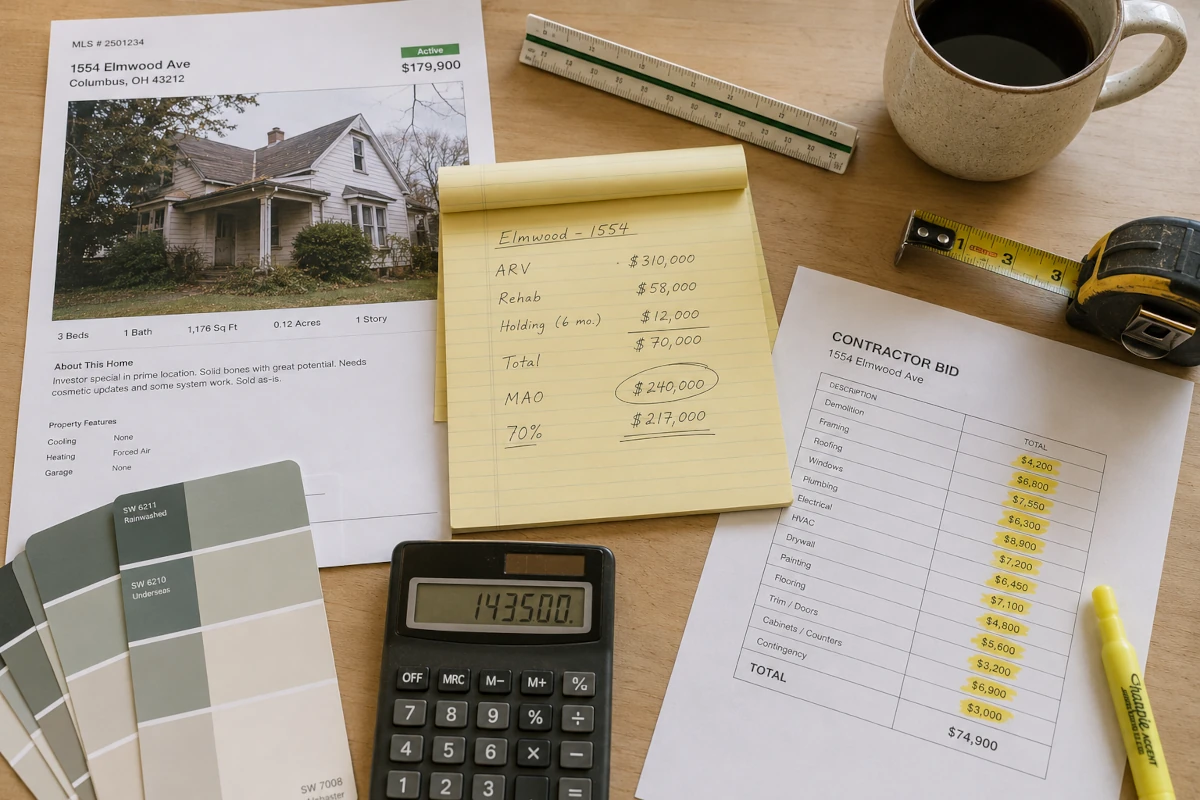
Here’s the framework applied to a realistic example. Suppose you’re evaluating a 3-bedroom, 2-bath single-family home that needs a moderate cosmetic rehab. Closed comps support an ARV of $350,000.
| ARV (closed-comp supported) | $350,000 |
| Estimated Rehab Cost | $55,000 |
| Rehab Contingency (12%) | $6,600 |
| Total Rehab Budget | $61,600 |
Apply the 70% rule to find your maximum offer:
| ARV × 70% | $245,000 |
| − Total Rehab Budget | $61,600 |
| Maximum Allowable Offer (MAO) | $183,400 |
That’s the ceiling. If the seller won’t take that or less, the deal isn’t there at the offered ARV. Now let’s say you negotiate to $180,000 and model the full profit picture:
| Purchase Price | $180,000 |
| Closing Costs on Purchase (2%) | $3,600 |
| Total Rehab Budget | $61,600 |
| Holding Costs (5 months @ $1,400/mo) | $7,000 |
| Selling Costs (8% of ARV) | $28,000 |
| Total Project Cost | $280,200 |
Net profit calculation:
| Sale Price (ARV) | $350,000 |
| − Total Project Cost | $280,200 |
| Net Profit | $69,800 |
| Net Profit as % of ARV | 19.9% |
| ROI on $80K Cash Invested | 87% |
A net profit of $69,800 on roughly $80,000 of cash invested (down payment + rehab + holding) is a strong flip. Anything netting 15%+ of ARV with a 4–6 month timeline is worth doing. Anything under 10% of ARV is marginal — the slightest cost overrun or ARV miss will erase the profit.
The discipline isn’t in the calculation, it’s in being honest with the inputs. A flipper who fudges ARV up by $20,000 and shaves rehab down by $10,000 sees $30,000 of profit that doesn’t exist. Most failed flips look great on the spreadsheet that justified the purchase.
Run your own numbers on any property with our Fix & Flip Calculator.
Where to Find Fix and Flip Property Deals
The MLS is the worst source of flip deals and also the most popular — which is exactly why it doesn’t work for most flippers. Every property on the MLS is seen by every other investor, agent, and owner-occupant in the market. The good distressed deals sell in days, often above asking, to whoever moves fastest.
Flippers who consistently find deals work multiple channels:
MLS with strict distress filters
Saved searches that filter for: price reductions of 5%+, days on market 90+, specific keywords (“handyman special,” “needs TLC,” “cash only,” “as-is”), and estate or trust sales. Most of what comes through will still be overpriced for a flip, but persistent monitoring catches the occasional motivated seller.
Wholesalers
The dominant deal source for most working flippers. Property wholesalers contract distressed properties and assign the contract for a fee (typically $5,000–$15,000). The quality range is enormous — legitimate wholesalers bring deals with real spread; bad ones inflate ARVs and lowball rehab estimates to move marginal properties. Build relationships with 3–5 wholesalers you’ve verified independently. Vet every deal’s ARV and rehab estimate yourself.
Off-market direct outreach
Direct mail to absentee owners, “driving for dollars” in target neighborhoods, and probate/divorce lead lists are how the most aggressive flippers find their best margins. Response rates are low (1–3%), but the deals that come through tend to have meaningful equity built in because the seller hasn’t shopped the property to anyone else.
Foreclosure and tax auctions
Sheriff sales, foreclosure auctions, and tax-lien auctions occasionally produce extraordinary spreads. They also produce catastrophic mistakes: title issues, occupancy problems, undisclosed liens, and properties you can’t even walk through before bidding. Not a beginner play. Investors who do auctions well have title companies and attorneys on retainer.
Estate sales and probate
Properties inherited by family members who don’t want to manage them often sell below market — sometimes well below. Probate court records are public; reaching out to executors before the property is listed can produce deals nobody else sees.
How to Finance a Fix and Flip Property
Conventional mortgages don’t work for fix and flip property. The closing timeline is too slow (30–45 days when sellers want to close in 7–14), the documentation burden too heavy, and most banks won’t lend on properties that need significant rehab. Flippers use specialized short-term financing.
Hard money loans
The default flip financing. Hard money lenders fund the deal based on the property’s ARV, not your personal income or credit alone. Typical terms: 10–13% interest, 2–4 points in origination fees, 6–18 month term, 10–20% down with rehab funds drawn in stages. Expensive on paper, but the speed (often 7–14 day close) and the rehab funding structure are designed for flippers. Read the fix & flip loan guide for full mechanics →
Bridge loans
Slightly cheaper than hard money (typically 8–11% interest), longer term (12–24 months), and structured for investors with stronger credit profiles. Used by flippers who need a longer timeline or for transition between properties. Less common than hard money for typical 4–6 month flips.
Cash
The cleanest financing terms exist for cash buyers because there are none. Cash closes fast, gives you negotiating leverage with sellers, and eliminates financing risk. The downside is capital lock-up — cash deployed into a flip can’t simultaneously fund another deal. Most flippers who can pay cash still don’t, because leveraging keeps the capital base working.
Private money / partners
Individual private lenders, friends and family, or equity partners. Terms vary wildly — some private money is cheaper than hard money, some is more expensive. The flexibility matters more than the rate. Partnerships work when one party brings capital and the other brings deal flow and operational execution; they fail when responsibilities aren’t written down.
BRRRR as an alternative
Buy, Rehab, Rent, Refinance, Repeat. Instead of selling the property after rehab, you place a tenant and refinance into a long-term DSCR or conventional loan, pulling most of your capital back out for the next deal. Mechanically similar to flipping through the rehab stage, but the exit is a rental hold instead of a sale. Better tax treatment (capital appreciates, depreciation shelters income) but slower capital velocity. Worth considering when comps support both ARV and strong rent numbers.
The Rehab: Scope, Budget, and Timeline
The rehab is where most flips succeed or fail. The math going in might be flawless, but if the renovation runs 6 weeks long and 30% over budget, the profit evaporates. Three principles separate flippers who stay in business from the ones who don’t:
Scope to the neighborhood, not your taste
The single most expensive mistake new flippers make is over-improving. A property in a $300,000 neighborhood with $80,000 of finishes will still sell at $300,000 — or worse, sit longer because it’s priced above its neighborhood ceiling. Walk three or four recently-sold comparable properties before settling on scope. Match the finish level, don’t exceed it. Quartz vs. granite, LVP vs. hardwood, IKEA cabinets vs. custom — the right answer depends entirely on what the neighborhood’s buyers expect at that price point.
Get a real number from a real contractor
Spreadsheet rehab estimates — “$30 per square foot for cosmetic, $60 for moderate, $100 for heavy” — are starting points, not budgets. Before you close on the property, walk it with the contractor who will actually do the work, get a line-item bid, and add a 10–15% contingency. If the contractor won’t walk the property pre-purchase, they’re not the right contractor for this deal.
Manage the timeline like it’s the budget
Every extra month of holding costs ~$1,200–$1,800 (taxes, insurance, utilities, financing interest). A flip that runs 3 months long burns $4,000–$5,000 in pure carrying cost — on top of whatever delayed-sale price compression happens because the market shifted. Use a written schedule with weekly check-ins, payments tied to milestone completion, and a written change-order process. Verbal “we’ll just add it to the bill” agreements are how rehabs blow budgets.
Permits: the right answer is “yes”
Unpermitted work shows up on inspection reports, scares off buyers, and creates legal exposure if anything goes wrong post-sale. The temptation to skip permits to save time and money is real; the cost of getting caught is much worse. Pull permits for structural, electrical, plumbing, and HVAC work. Cosmetic finishes typically don’t require them.
Mistakes That Wipe Out Flippers
Failed flips follow predictable patterns. The expensive seven:
1. ARV inflation
Pulling comps that support the price you want rather than the price the market will pay. Active listings, pending sales, and properties with materially different specs (square footage, lot size, finished basement) don’t count as comps. Only closed sales of comparable properties within 90 days and a half-mile radius do.
2. Rehab underestimation
The corollary to ARV inflation. New flippers consistently under-budget by 20–30%, then blame the contractor when reality lands. The contingency line item exists for a reason.
3. Over-improving for the neighborhood
Spending $90,000 to add features that the next buyer at this price point doesn’t value. Granite countertops in a $200,000 neighborhood are wasted money; vinyl plank in a $600,000 neighborhood is a deal-killer. Match the finish level to the comps.
4. Contractor mismanagement
Paying too much upfront, no written scope, no milestone payments, no penalty for missed deadlines. The same contractor who delivers on time and on budget for a friend can run a stranger’s flip 60 days long. Structure the agreement to align incentives.
5. Wrong financing
Taking the first hard money offer instead of shopping 3–4 lenders. A 2-point difference in origination on a $200,000 loan is $4,000 of pure cost; a 2% interest rate spread over 5 months is another $2,000. Financing is negotiable on every flip.
6. Holding too long
Listing the property before staging is done. Refusing to drop the price when it sits on the market. Chasing the market down instead of pricing aggressively from day one. Time is the silent killer of flip profit — every extra month of holding costs ~$1,500.
7. Skipping the inspection
Inspections are $300–$500 and routinely catch $5,000–$50,000 problems that change the deal math. Foundation issues, hidden water damage, electrical hazards, failed septic systems — all things you can’t see during a walkthrough but a competent inspector can. Always inspect.
Frequently Asked Questions
For a typical hard-money-financed flip on a $200,000 purchase with $60,000 rehab, expect to bring $50,000–$80,000 in cash to close: 10–20% down on purchase, points and closing costs, the first month or two of rehab funds before draws kick in, and reserves for holding costs. Cash-only flippers obviously need more.
Net profit of 15–20% of ARV is the target for a healthy flip. Above 20% is excellent. Below 10% is dangerous — the smallest cost overrun or ARV miss wipes out the profit. On a $350,000 ARV property, that translates to $52,000–$70,000 of net profit after all costs.
4–6 months from purchase to sale is the typical target: 2–3 months for rehab, 1–2 months for listing and sale, and some buffer for delays. Heavier rehabs (structural, additions, full mechanicals) can run 8–12 months. Cosmetic-only flips can sometimes close in 90 days.
In practice, very rarely — and not on your first deal. Some experienced flippers structure 100% LTC (loan-to-cost) deals with private money or partners, but these typically require a deal-flow track record the lender or partner can verify. New flippers should plan on 10–20% of purchase plus rehab reserves in cash.
Yes, with discipline. Higher hard money rates have compressed margins, which means deal selection matters more than it did in cheap-money years. Markets with strong end-buyer demand, available distressed inventory, and reasonable contractor pricing still produce 15%+ flips. Markets with stretched valuations and labor shortages don’t.
Use an agent for almost every flip. The 2.5–3% listing commission is real, but a competent agent will sell the property faster and often at a higher net price than FSBO — both of which matter more than the commission saved when you’re paying $1,500/month in holding costs. The exception is investors with their own real estate license who can list directly.
Get Funded
Fund Your Next Fix & Flip
Fast hard-money and bridge financing built for flips — competitive terms so you can close and start the rehab.
Check Your EligibilityFunding in as little as 7 days · No impact to your credit score