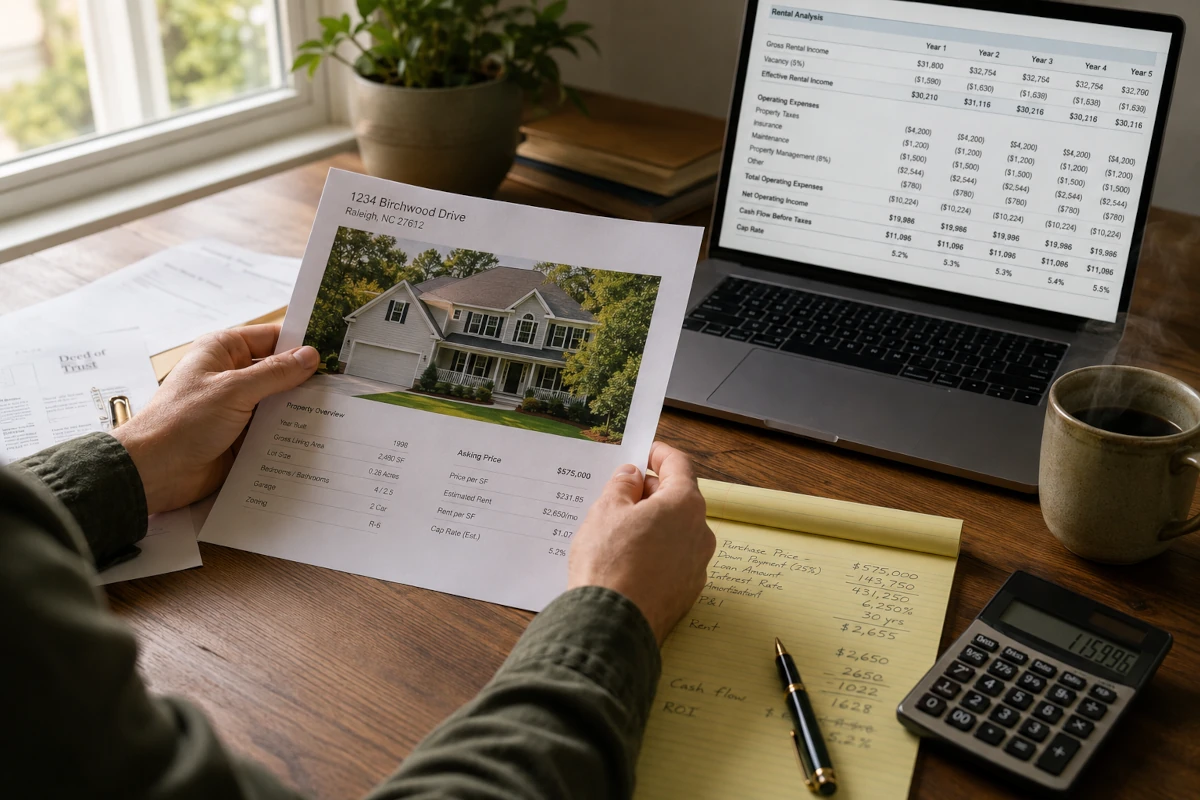
Why Invest in Rental Property
Rental property is one of the few wealth-building assets that pays you while it grows. A well-bought rental generates income from the first month, appreciates over time, lets you defer taxes through depreciation and 1031 exchanges, and amplifies your equity through leverage in a way no other widely-accessible asset class does.
That’s the case in one sentence. The longer version comes down to four mechanics working at the same time:
1. Cash flow
A rental property collects rent every month. If rent exceeds the mortgage, taxes, insurance, maintenance, and vacancy reserves, the surplus is yours. Unlike stock dividends, rental income tends to rise with inflation — rents in most US metros have outpaced CPI over the last two decades.
2. Appreciation
US single-family home values have appreciated at roughly 4–5% per year averaged over the long term, with substantial regional variation. When you invest in rental property with leverage, that 4–5% applies to the full property value, not just your down payment — which is how a modest appreciation rate can produce 16–20% annualized returns on equity in the early years of ownership.
3. Tax treatment
Rental property owners can depreciate the building (not the land) over 27.5 years, generating a non-cash expense that often shelters most or all of the rental income from taxes. When you sell, you can defer capital gains entirely through a 1031 exchange into another investment property. No other widely-held asset offers this combination.
4. Leverage with the tenant’s money
A rental property is the only asset most people will ever own where the loan that buys it gets paid down by someone else. Every month the tenant pays rent, they’re not just covering your expenses — they’re amortizing your mortgage. After 30 years (sooner with positive cash flow accelerating the payoff), the loan is gone and the equity is yours.
The combination of these four — not any single one — is what makes rental property unique. You can find cash flow elsewhere (bonds, dividend stocks). You can find appreciation elsewhere (growth stocks, gold). You can find tax shelter elsewhere (retirement accounts). But the only asset class that stacks all four with accessible leverage is real estate.
What Makes a Rental Property Worth Buying
Most rental properties listed on the MLS are not investment-grade. They’re priced for owner-occupants, not for investors who need the property to pay for itself. Before you invest in rental property, you need a clear filter for what “worth buying” actually means.
The four filters that matter:
Filter 1: The rent covers the mortgage with margin
This is captured by the DSCR ratio (Debt Service Coverage Ratio): monthly rent ÷ monthly mortgage payment. A DSCR of 1.0 means the property breaks even. Below 1.0 means you’re feeding the property out of pocket every month. Most experienced investors won’t buy below 1.20x because the buffer is what protects you from vacancy, repairs, and rate movements.
Filter 2: Cash flow is positive after every real expense
Mortgage isn’t your only cost. Property taxes, insurance, vacancy reserves (typically 5–8%), maintenance reserves (1–2% of property value annually), property management (8–10% even if you self-manage, because your time has value), and capital expenditures (roof, HVAC, water heater) all draw from the same rent check. A property that “cash flows” $200 a month before any of these expenses is not actually a cash-flowing property.
Filter 3: The cap rate is competitive with the local market
Cap rate (capitalization rate) is the property’s Net Operating Income (NOI) divided by the purchase price. It’s the unlevered yield — what the property earns ignoring how it’s financed. Cap rates of 5–7% are common in most US metros. Cap rates of 8%+ are increasingly hard to find and usually signal either a problem property, a transitional neighborhood, or a Midwest market with slower appreciation potential.
Filter 4: The price-to-rent ratio matches investor math
A useful screening number: divide the purchase price by the annual gross rent. Ratios under 12 (rent is more than 1/12 of the price annually) tend to cash flow easily. Ratios over 20 require either appreciation play or extremely cheap financing to justify. Most cash-flowing markets sit in the 9–14 range.
When you invest in rental property, you’re underwriting all four of these at once. A deal that nails three out of four can still be a great buy. A deal that fails two of four is almost always a pass.
How to Analyze a Rental Deal
Once you’ve filtered by the high-level metrics, the next step is running the actual deal math. Here’s the framework experienced investors use, scaled down to the essentials.
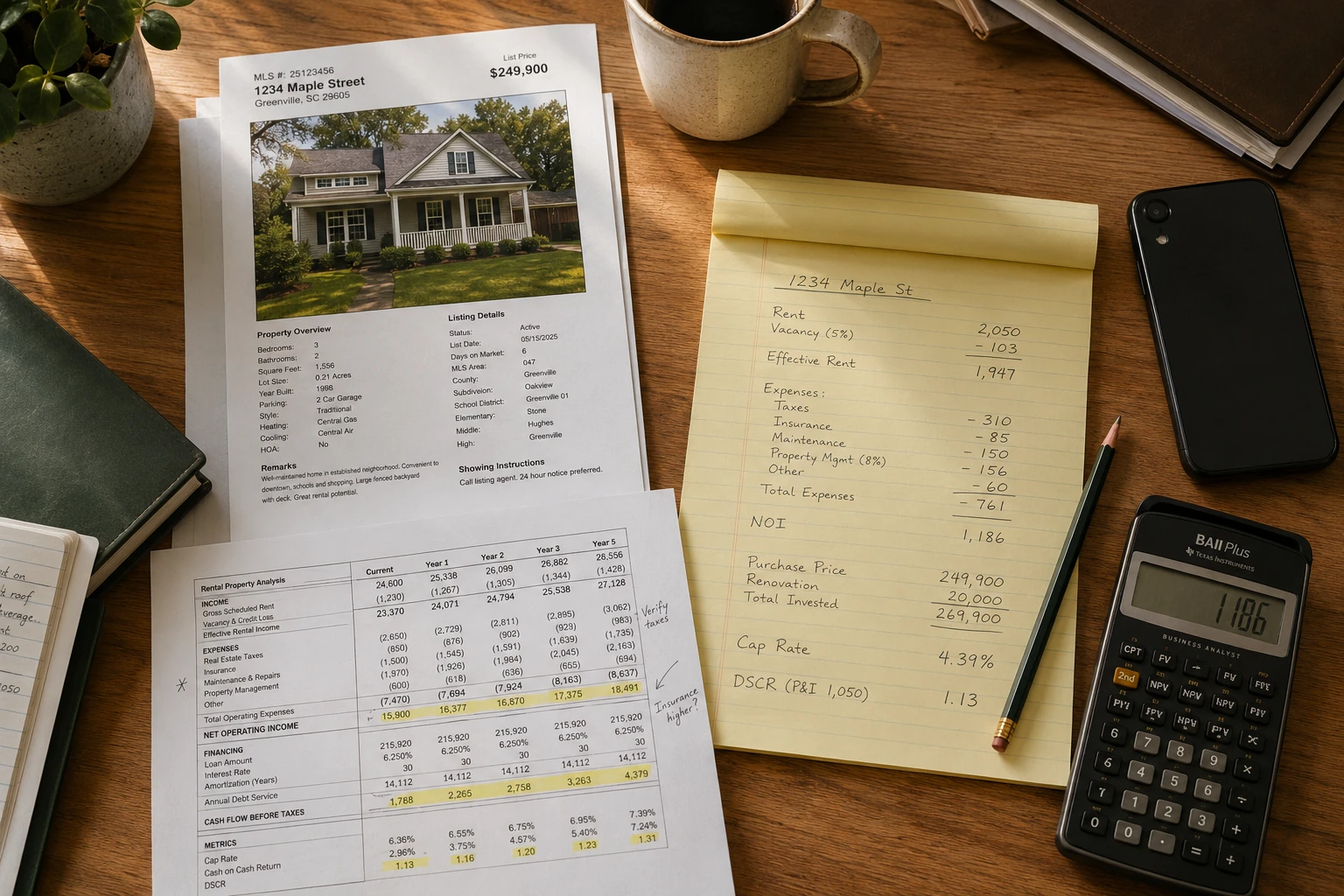
Start with monthly cash flow. Suppose you’re evaluating a $200,000 single-family rental that should rent for $2,800/month, financed with a 25% down DSCR loan at current rates:
| Gross Monthly Rent | $2,800 |
| Vacancy Reserve (6%) | −$168 |
| Property Management (8%) | −$224 |
| Maintenance Reserve (1% annual) | −$167 |
| CapEx Reserve | −$100 |
| Monthly NOI | $2,141 |
Annualize the NOI ($25,692/yr), then subtract the annual debt service (P&I + taxes + insurance, typically called PITIA) to get true annual cash flow:
| Annual NOI | $25,692 |
| Annual Debt Service (PITIA) | −$20,400 |
| Annual Cash Flow | $5,292 |
Then check cap rate and DSCR:
| Cap Rate | $25,692 ÷ $200,000 = 12.85% |
| DSCR | $2,141 ÷ $1,700 = 1.26x |
A DSCR of 1.26x, cash flow of $5,292/year after all reserves, and a 12.85% cap rate would be a strong deal in any market. (Note: this example uses a Midwest cash-flow market; West Coast cap rates rarely exceed 5%, and the analysis would lean more heavily on appreciation than cash flow.)
The bigger lesson isn’t the specific numbers — it’s that the analysis only works if you include every real expense. Most deal advertisements quote you “cash flow” after only the mortgage, leaving out vacancy, management, maintenance, and CapEx. That’s not analysis. That’s marketing.
If you want to skip the spreadsheet, our free DSCR Calculator runs the same math in 30 seconds with no signup required.
Where to Find Rental Property Deals
The MLS is the most accessible source of rental property deals, but it’s also the most picked-over. Every deal on the MLS has been seen by every other buyer in the market. The good ones go fast and the rest are usually priced above what investor math supports.
Investors who consistently find good deals to invest in rental property work multiple sources at once:
MLS with strict filters
Set saved searches that filter for: price-to-rent ratio (use rent estimates from Rentometer or Zillow Rental Manager to calculate), days on market (60+ days often signals motivated sellers), and price reductions (signals the asking price was wrong from the start). Be ready to act fast on anything that meets your criteria — on a strong deal you’re often competing with a dozen other investors.
Wholesalers
Property wholesalers contract distressed properties and assign the contract to investors for a fee. Quality varies enormously — the good ones bring legitimate deals with room to move; the bad ones inflate ARVs and rehab budgets to make marginal properties look good. Vet every wholesale source independently before trusting their numbers.
Off-market direct
Direct mail, “driving for dollars,” and probate or divorce lead lists are how the most aggressive investors find their best deals. The work is brutal and the response rates are low (often 1–3%), but the deals that come through tend to have meaningful equity built in.
Auctions
Sheriff sales, foreclosure auctions, and tax-lien auctions can produce extraordinary deals — and also catastrophic mistakes if you bid on a property with title issues, occupancy problems, or hidden damage. Not a beginner play.
For most investors starting out, MLS combined with one or two off-market channels is the right mix. It gives you exposure to high-volume listings while surfacing the occasional motivated seller other buyers never see.
How to Finance a Rental Property
How you finance a rental property is almost as important as the property itself. The wrong financing can turn a great deal into a marginal one, or make a marginal deal unworkable.
The three loan types most rental investors use:
Conventional investment property loans
Backed by Fannie Mae and Freddie Mac, these qualify you based on your personal income (W-2s, tax returns, DTI). Rates are the lowest available, down payment is typically 20–25%, and you can hold up to 10 financed properties under conventional guidelines. Best for: investors with strong W-2 income and 1–3 properties.
DSCR loans
Qualified based on the property’s rental income, not your personal income. No tax returns, no W-2s, no DTI calculation. Rates run roughly 1–2 points higher than conventional, but qualification is dramatically simpler and ownership through an LLC is straightforward. Best for: self-employed investors, investors with multiple properties, anyone whose tax returns show low taxable income from legal write-offs. Read the full DSCR loan guide →
Portfolio loans and commercial loans
Held on a bank’s balance sheet rather than sold to Fannie/Freddie. Underwriting is bank-specific, often more flexible than conventional but more expensive. Useful for non-standard properties, large portfolios, or borrowers with unique situations.
The standard play for most rental investors past their first 2–3 properties is to start with conventional and pivot to DSCR. Conventional uses your DTI for qualification, which gets tighter every time you add a property. DSCR doesn’t care about your DTI — each property qualifies on its own merits. Most investors hit a wall on conventional around 4–5 properties; the ones who keep scaling are the ones who switched to DSCR before they hit it.
When you invest in rental property at scale, the underwriting structure becomes the constraint, not the deal flow. Set yourself up for that transition early.
Common Mistakes First-Time Investors Make
The pattern of how first deals go wrong is remarkably consistent across markets and time periods. The expensive six:
Underestimating expenses
The classic mistake. New investors run their numbers with mortgage + taxes + insurance and call it cash flow. The reality is that the long-term cost of owning a rental is 40–50% of gross rent once you include vacancy, management, maintenance, and CapEx. A property that “cash flows $400” before reserves often cash flows zero or negative after them.
Buying in markets they don’t understand
Out-of-state investors who buy properties they’ve never visited, in markets they don’t know, on the word of an agent or wholesaler they’ve never met, take losses at a rate that surprises them. Markets have their own tenant quality, regulatory environment, eviction timelines, and seasonal patterns. Learn the market before you buy in it.
Choosing properties by personal taste, not investor math
“I’d love to live here” is not an investor filter. Properties that appeal to owner-occupants are usually priced for owner-occupants, which is incompatible with cash flow. The best investor properties tend to be the ones an owner-occupant would walk past.
Financing with too little money down
Just because you can put 15% down on an investment property doesn’t mean you should. The lower your equity, the smaller a market shift it takes to put you underwater. 25% down is the standard for a reason — it’s the level at which most rental properties have enough buffer to weather a downturn without becoming a forced sale.
Skipping the inspection
Inspections cost $300–500 and routinely catch $5,000–$50,000 problems. Investors who skip inspections to “win the deal” are paying for the seller’s information advantage with their own money. Always inspect, always.
Mis-estimating rent
New investors take the listing agent’s rent estimate or Zillow’s number at face value. Experienced investors pull comps from Rentometer, drive the neighborhood, and call comparable properties as a prospective tenant to see what landlords are actually getting (not asking). The asking-rent versus leased-rent gap is often 5–10% in either direction depending on the market.
How to Scale Beyond Your First Property
Most investors who buy a rental property never buy a second one. The reason is usually structural, not financial — they didn’t set up the first deal in a way that made the second one easier.
The patterns that distinguish portfolio-builders from one-and-done buyers:
They underwrite the second deal before they close the first
The financing structure for property #1 matters most for what it does to your ability to qualify for #2. A conventional loan with high DTI utilization is fine for #1 but cuts off your conventional options for #2–#5. DSCR-eligible properties don’t have this problem because each one qualifies on its own merits.
They build a reusable team early
A reliable property manager, contractor, accountant, and lender for the first property is also the team for the next ten. Investors who hire ad hoc for each property burn weeks on every deal. Investors who build a small bench scale 10x faster.
They reinvest cash flow systematically
Cash flow from property #1 isn’t pocket money — it’s the down payment seed for property #3 or #4. Investors who treat rental income as ordinary spending money rarely buy a third property; investors who route it into a “next-property fund” almost always do.
They use 1031 exchanges to reposition
A property that’s done its job (low cap rate after years of appreciation) can be 1031-exchanged into multiple properties in higher-cash-flow markets, deferring taxes entirely. Investors who hold the same five properties for 30 years build wealth at a slower rate than investors who roll equity into new properties every 5–7 years.
When you invest in rental property strategically — meaning, with property #5 in mind when you buy property #1 — the trajectory looks completely different from the people who bought a single rental and stopped.
Frequently Asked Questions
For a standard 20–25% down conventional or DSCR loan, you need 20–25% of the purchase price plus 2–4% in closing costs, plus roughly 6 months of mortgage payments in reserves. On a $200,000 property, that’s typically $50,000–$60,000 total cash to close.
$200–$300 per door per month is a common minimum target after all expenses including reserves. Higher cash flow is always better, but properties that hit this number consistently in B-class neighborhoods are buyable at scale.
Both work. In-state is easier to manage and inspect personally but limits you to your local pricing. Out-of-state opens up cash-flow markets in the Midwest and Southeast but requires a strong local team and willingness to manage remotely.
You can, but the financing options narrow significantly. DSCR loans require roughly 660–680 minimum FICO. Hard money is available with weaker credit but at much higher rates. The cheapest path to investing in rentals starts with 720+ FICO.
Yes, with selectivity. Higher interest rates have compressed cash flow in many markets, which means deal selection matters more than ever. Markets with strong rental demand, sustainable price-to-rent ratios, and growing economies still produce strong returns. Markets with stretched valuations and weak job growth don’t.
For most investors, yes — eventually. An LLC provides liability separation between your rental property and your personal assets. Note that conventional loans don’t allow LLC ownership without refinancing, while DSCR loans typically do. Most investors buy in personal name with the first 1–2 properties, then form an LLC and use DSCR loans for subsequent ones. Consult a CPA and attorney before structuring — this isn’t legal or tax advice.
Get Funded
Finance Your Rental Property
Long-term rental financing that qualifies on cash flow — scale your portfolio without the income docs.
Check Your EligibilityFunding in as little as 7 days · No impact to your credit score