
What Are Short-Term Rental Loans?
A short-term rental (STR) loan is an investment property mortgage used to purchase or refinance properties that will be operated as vacation rentals on platforms like Airbnb, VRBO, and Booking.com. While there is no single loan product called a "short-term rental loan," the term refers to financing products that accommodate STR income in their underwriting.
The most common financing vehicle for STR investors is the DSCR loan, which qualifies borrowers based on the property's rental income rather than personal income. DSCR lenders increasingly offer STR-specific programs that accept projected short-term rental revenue — not just traditional long-term lease income — when calculating the debt service coverage ratio.
This is significant because STR properties in desirable locations often generate 2x to 3x the income of an equivalent long-term rental. Using STR income projections instead of a traditional rent appraisal can dramatically improve your DSCR ratio and qualify you for larger loan amounts or better terms.
Loan Options for Short-Term Rental Properties
STR investors have several financing paths, each with different trade-offs:
DSCR Loans (Most Popular for STR)
DSCR loans are the go-to financing for STR investors because they qualify based on property income, not personal income. Many DSCR lenders now offer STR-specific underwriting that accepts projected Airbnb/VRBO income. Key advantages include no income documentation, LLC ownership, and 30-year fixed terms. Learn more about using DSCR loans for Airbnb properties.
Conventional Loans
If you have fewer than 10 financed properties and strong documentable income, a conventional investment property loan offers the lowest rates. The catch: conventional underwriting uses long-term rental income only (75% of the appraised market rent), ignoring the STR premium entirely. You also cannot hold the property in an LLC.
Fix and Flip to STR (BRRRR Strategy)
Some investors purchase undervalued properties with a fix and flip loan, renovate and furnish them for STR use, then refinance into a DSCR loan once the property has booking history. This strategy lets you build equity through renovation and capture the STR income premium on the refinance.
Portfolio Loans
Local banks and credit unions sometimes offer portfolio loans (held on their own books rather than sold to the secondary market) with flexible underwriting that can accommodate STR income. These are worth exploring in markets where you have a relationship with a community bank.
How STR Income Is Underwritten
The biggest question in STR financing is: how does the lender determine what the property will earn? There are three primary methods:
Method 1: Traditional Rent Appraisal (Form 1007)
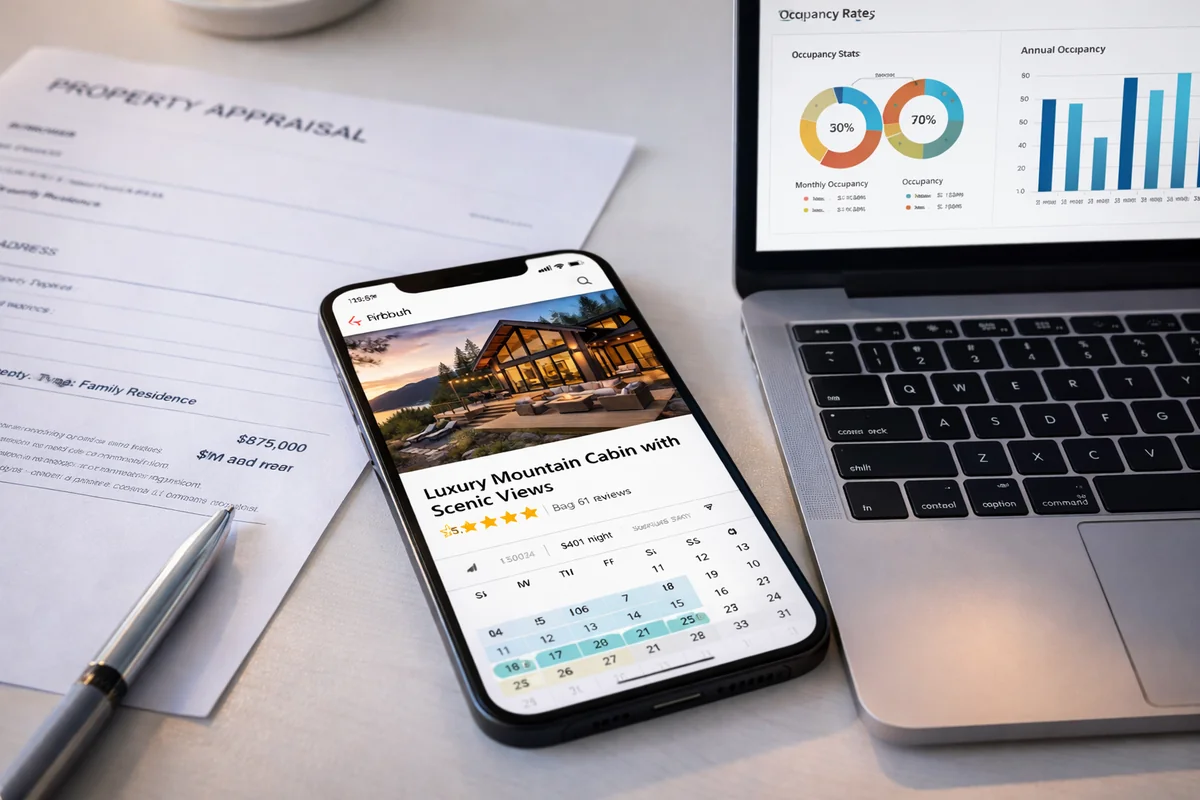
The appraiser estimates what the property would earn as a traditional long-term rental. This is the most conservative method and is used by default by most DSCR lenders. The downside: it completely ignores the STR income premium, potentially undervaluing your property's earning power by 50% or more.
Method 2: Third-Party STR Income Projections
Platforms like AirDNA, Rabbu, and Mashvisor provide data-driven revenue projections based on comparable STR listings in the area. Some DSCR lenders accept these projections as the basis for DSCR calculation, often using 75% of the projected gross revenue to account for vacancy and operating expenses. This typically produces a much higher qualifying income than the Form 1007 method.
Method 3: Actual Booking History
If you are refinancing an existing STR property, some lenders will use your actual 12-month booking history from Airbnb, VRBO, or your property management software. This is the most favorable method because it reflects real, proven income rather than projections.
Which Method Should You Pursue?
Always ask your lender upfront which income methods they accept. If they only use Form 1007, your DSCR may be artificially low. Shopping for a lender that accepts AirDNA projections or booking history can mean the difference between approval and denial — or between a mediocre rate and a great one.
STR Loan Qualification Requirements
Requirements for STR financing mirror standard DSCR loans with a few additional considerations:
Credit Score
Minimum 680 FICO for most STR-specific DSCR programs (slightly higher than the 660 minimum for standard DSCR). Borrowers with 740+ access the best rates.
Down Payment
Expect 25% down for STR purchases, which is slightly higher than the 20% minimum on standard rental property DSCR loans. Some lenders require 30% down in markets they consider high-risk for STR regulation changes.
DSCR Ratio
Most lenders require a minimum 1.0 to 1.25 DSCR using their accepted income method. Properties in premium vacation markets with strong projected revenue often achieve DSCR ratios of 1.5 to 2.0+, making qualification straightforward.
Reserves
6 to 12 months of mortgage payments in reserves after closing. STR properties carry seasonal income variability, so lenders want a larger cash cushion than for traditional rentals.
STR-Specific Requirements
- Legal compliance: Many lenders require proof that the property is in a jurisdiction where short-term rentals are legally permitted. Some require a copy of the STR license or permit.
- Management plan: Evidence of how the property will be managed — either self-managed with documented systems or through a professional STR management company.
- Furnishing budget: For new STR properties, lenders may want to see your furnishing and setup plan, which typically runs $10,000 to $30,000 depending on the property size.
STR Regulations and Legal Considerations
The regulatory landscape for short-term rentals is the single biggest risk factor for STR investors. Rules vary dramatically by city, county, and state, and they are changing constantly.
Common Regulatory Frameworks
- Permitting: Most STR-friendly cities require a permit or license. Some are easy to obtain; others have caps, lotteries, or waitlists.
- Occupancy taxes: STR operators are typically required to collect and remit hotel/occupancy taxes. Platforms like Airbnb handle this automatically in many jurisdictions.
- HOA restrictions: Condos and planned communities often have HOA rules that restrict or prohibit short-term rentals. Always review the CC&Rs before purchasing.
- Zoning: Some cities only allow STRs in specific zones or require the property to be the owner's primary residence (eliminating investor STR use entirely).
- Night caps: Some jurisdictions limit the number of nights per year a property can be rented short-term (commonly 90 to 180 nights).
Protecting Your Investment
Before purchasing an STR property, conduct thorough regulatory due diligence: review current local ordinances, attend city council meetings where STR rules are being discussed, and consult a local real estate attorney. Also consider what happens to your investment if regulations change. The best STR investments are properties that would still cash-flow as a long-term rental if STR rules tighten — this gives you a fallback exit strategy.
Top Markets for Short-Term Rental Investment
The most profitable STR markets share several characteristics: strong tourism demand, limited hotel supply, favorable regulations, and year-round (or strong seasonal) visitor traffic. Here are market categories to consider:
Vacation Destination Markets
Beach towns, mountain communities, and resort areas with consistent tourism draw. Examples include Gulf Coast Florida, Smoky Mountains Tennessee, and desert communities in Arizona. These markets offer the highest gross revenues but often have the most seasonal variability.
Urban Experience Markets
Major cities where visitors prefer the Airbnb experience over hotels. Nashville, Austin, New Orleans, and Savannah are popular examples. Urban STRs face the highest regulatory risk but benefit from year-round demand from business travelers, tourists, and event attendees.
Emerging Markets
Smaller cities and towns experiencing tourism growth where regulations have not yet caught up. These markets offer lower entry prices and less competition but require more research to validate demand. Data from AirDNA and Mashvisor can help identify emerging markets with strong STR potential.

Maximizing Short-Term Rental Revenue
STR income is not passive — it is an operating business. The difference between a mediocre STR and a top performer comes down to execution:
Dynamic Pricing
Use automated pricing tools like PriceLabs, Beyond Pricing, or Wheelhouse that adjust your nightly rate based on demand, seasonality, local events, and competitor pricing. Dynamic pricing can increase annual revenue by 15–30% compared to static rates.
Listing Optimization
Professional photography, compelling descriptions, and strategic amenity highlights drive bookings. Properties with professional photos earn up to 40% more than those with amateur shots. Highlight unique features: hot tubs, game rooms, scenic views, proximity to attractions.
Guest Experience
Five-star reviews drive search ranking on Airbnb and VRBO. Invest in quality furnishings, provide clear check-in instructions, respond to messages within an hour, and include thoughtful touches (local guides, welcome baskets, quality linens).
Multi-Platform Distribution
List on Airbnb, VRBO, Booking.com, and your own direct booking website. Each platform reaches a different audience. Use a channel manager (Hospitable, Guesty, OwnerRez) to sync calendars and avoid double bookings.
Property Management Options
How you manage your STR significantly impacts both revenue and your lifestyle:
Self-Management
You handle everything: guest communication, cleaning coordination, maintenance, pricing, and reviews. Most viable for local investors with 1 to 3 properties. Tools like Hospitable and Turno automate much of the workflow. Self-management maximizes profit margins but requires consistent attention.
Professional STR Management Companies
Full-service STR managers handle everything from listing creation to guest communication to cleaning. Fees typically range from 20% to 35% of gross revenue. This is the right choice for remote investors, those with larger portfolios, or investors who want truly passive income. When evaluating managers, compare their average occupancy rates and revenue per property against your AirDNA projections.
Hybrid Approach
Many investors self-manage the business side (pricing, listings, guest communication) while outsourcing the physical operations (cleaning, maintenance, emergency calls) to local teams. This middle ground typically costs 10–15% of revenue and keeps you in control of the guest experience.
Pros and Cons of Short-Term Rental Investing
Frequently Asked Questions
Yes. DSCR loans are the most common financing for Airbnb and VRBO properties. Many DSCR lenders offer STR-specific programs that accept projected short-term rental income for qualification.
Three methods: a traditional rent appraisal (Form 1007), third-party STR income projections from platforms like AirDNA, or actual booking history for refinances. The method used significantly affects your qualifying DSCR ratio.
Most STR-focused DSCR programs require a minimum 680 FICO score. Borrowers with 740 or above access the best rates and terms.
Expect 25 percent down for STR purchases, slightly higher than the 20 percent minimum on standard DSCR loans. Some lenders require 30 percent in markets with regulatory uncertainty.
Not for DSCR loans. However, having a property management plan or agreement with a professional STR manager strengthens your application.
This is the primary risk. Invest in properties that would still cash-flow as long-term rentals if regulations change. Also consider markets with established, stable STR regulatory frameworks.
Budget 10,000 to 30,000 dollars depending on the property size and market positioning. Higher-end furnishings in premium markets can command significantly higher nightly rates.
Self-management maximizes profits but requires consistent attention. Professional management costs 20 to 35 percent of gross revenue but is ideal for remote investors or those with larger portfolios.
List on multiple platforms: Airbnb, VRBO, and Booking.com at minimum. Use a channel manager to sync calendars across platforms and avoid double bookings.
Yes, though excessive personal use can affect your tax deductions. The IRS allows personal use up to 14 days per year or 10 percent of rental days without losing rental property tax benefits.
Get Funded
Finance Your Short-Term Rental
DSCR financing that qualifies on projected STR income — built for Airbnb and vacation-rental investors.
Check Your EligibilityFunding in as little as 7 days · No impact to your credit score