
What Is a DSCR Loan?
A DSCR loan (Debt Service Coverage Ratio loan) is a type of investment property mortgage that qualifies borrowers based on the property's rental income rather than the borrower's personal income. Instead of reviewing your W-2s, tax returns, or pay stubs, lenders evaluate whether the property generates enough income to cover its own mortgage payment.
Ready to see program terms? Our DSCR loans page lists who qualifies, typical terms, and how to apply. For the full qualification checklist, see DSCR loan requirements.
This makes DSCR loans the preferred financing tool for real estate investors who are self-employed, have complex tax situations, or simply want a faster, documentation-light path to closing on investment properties.
The term "DSCR" refers to a simple ratio that compares the property's Net Operating Income (NOI) to its total debt service (the annual mortgage payment including principal, interest, taxes, insurance, and HOA if applicable).
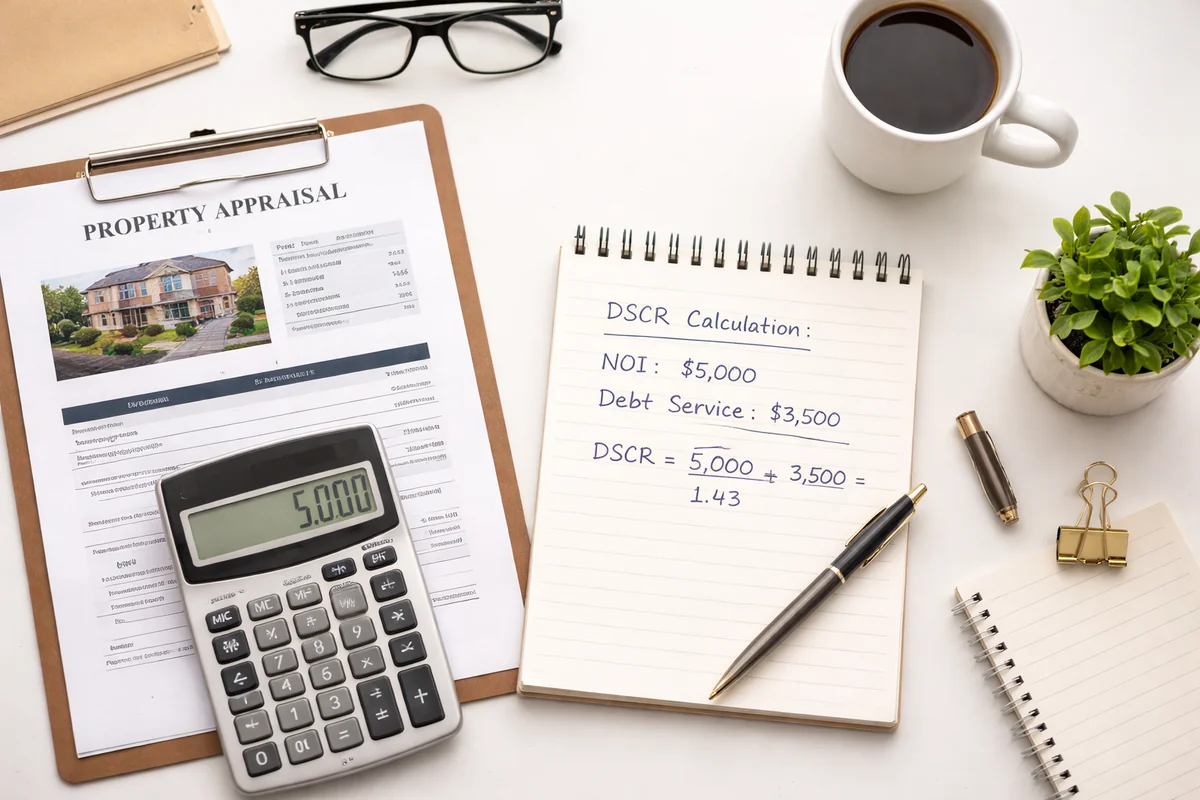
DSCR Calculation Example
Suppose you are purchasing a rental property with the following numbers:
| Monthly Rent | ,500 |
| Annual Gross Rent | 0,000 |
| Vacancy & Maintenance (5%) | - ,500 |
| Net Operating Income (NOI) | 8,500 |
| Annual Mortgage Payment (PITIA) | 2,800 |
| DSCR Ratio | 1.25 |
A DSCR of 1.25 means the property generates 25% more income than needed to cover the mortgage. Most lenders consider this a strong ratio that comfortably qualifies for financing.
Want to run your own numbers? Try our free DSCR Calculator — it takes 30 seconds and no sign-up is required.
How DSCR Loans Work
DSCR loans are categorized as Non-QM (Non-Qualified Mortgage) products, meaning they fall outside the standard underwriting guidelines used by Fannie Mae and Freddie Mac. This is actually an advantage for investors because it removes the biggest bottleneck in conventional lending: income documentation.
Income Qualification
With a conventional loan, lenders verify your personal income through tax returns, W-2s, and pay stubs. They calculate your debt-to-income ratio (DTI) across all your obligations. This process becomes increasingly difficult for investors who own multiple properties or who use legal write-offs that reduce their taxable income on paper.
With a DSCR loan, the lender skips personal income verification entirely. Instead, they order a rent schedule (Form 1007) or use a lease agreement to determine the rental income potential, then compare that to the projected mortgage payment. If the ratio meets their minimum threshold, you qualify.
Credit Score Requirements
While DSCR lenders skip income docs, they still evaluate creditworthiness. Most require a minimum FICO score of 660 to 680, though some programs accept scores as low as 620 with compensating factors like a higher down payment or a stronger DSCR ratio. Borrowers with 740+ credit will access the best rates and terms.
Down Payment
Expect to put 20% to 25% down on a DSCR loan. This is slightly higher than conventional investment property loans (which can go as low as 15%), but the trade-off is worth it for investors who cannot or prefer not to document personal income. Some lenders offer reduced down payment options at 15% for borrowers with higher credit scores and strong DSCR ratios.
Loan Terms and Structure
DSCR loans come in a variety of structures to match different investment strategies:
- 30-year fixed rate: The most common option for buy-and-hold investors seeking predictable payments and long-term stability.
- Adjustable rate (ARM): 5/1 or 7/1 ARM products that offer lower initial rates, useful for investors planning to refinance or sell within a few years.
- Interest-only: Available from some lenders, these maximize monthly cash flow by deferring principal payments for the first 5 to 10 years.
- 40-year term: Extended terms that reduce monthly payments, helping properties meet DSCR thresholds more easily.
Most DSCR loans are available for amounts ranging from $200,000 to $3 million, with some lenders going higher for well-qualified borrowers.
DSCR Loan Requirements
While DSCR loans are significantly easier to qualify for than conventional mortgages, they are not a free-for-all. Here are the standard requirements you should expect across most DSCR lenders in 2026:
Minimum DSCR Ratio
Most DSCR programs look for a ratio of 1.0 or higher. A 1.0 DSCR means the rent exactly covers the payment; a 1.25 DSCR means the rent is 25% more than the payment. Some programs go as low as 0.75, usually with lower maximum leverage and higher reserves. See how 0.75 DSCR and no-ratio loans work.
Credit Score
The typical minimum is 660 FICO, and scores of 720+ get the most competitive terms. Below that, expect pricing adjustments and, on some programs, lower maximum leverage.
Down Payment and LTV
Standard down payment is 20% to 25% (75–80% loan-to-value). Some programs go as high as 85% LTV for borrowers with exceptional credit and DSCR ratios above 1.25. Cash-out refinances are typically capped at 70–75% LTV.
Reserves
Lenders require 6 to 12 months of mortgage payment reserves in liquid or semi-liquid accounts after closing. This protects against vacancy or unexpected expenses. If you own multiple investment properties, some lenders require reserves for each.
Property Types
Most DSCR programs accept:
- Single-family homes (1–4 units)
- Townhomes and condos (warrantable and some non-warrantable)
- 2–4 unit multifamily
- Short-term rentals (Airbnb/VRBO properties, with specialized underwriting)
- 5+ unit multifamily (limited, varies by lender)
Properties must be investment properties only. You cannot use a DSCR loan for a primary residence or a second home.
Borrowing Entity
DSCR loans can be taken in your personal name or through an LLC, corporation, or trust. Many investors prefer vesting in an LLC for liability protection, and most DSCR lenders accommodate this without requiring a personal guarantee beyond the standard recourse structure.
DSCR Loan Rates Explained
DSCR loans usually price above conventional investment property loans, because they skip income verification. Your rate depends on your credit score, loan-to-value, DSCR ratio, loan amount, and prepayment terms, so two investors on the same day can see very different pricing. Read our breakdown of what drives DSCR rates.
What Affects Your DSCR Rate?
Several factors influence the interest rate you will receive:
- Credit score: The single biggest factor. Pricing generally improves at each higher credit tier.
- Loan-to-value (LTV): Higher down payments earn better rates. A 25% down payment property will price better than a 20% down deal.
- DSCR ratio: Properties with a 1.25+ DSCR receive preferential pricing compared to properties at or near 1.0.
- Property type: Single-family homes get the best rates. Condos, 2-4 units, and short-term rentals may carry slight price adjustments.
- Loan amount: Loans below $150,000 often carry higher rates due to minimum profitability requirements for lenders.
- Prepayment penalty: Accepting a longer prepayment penalty period generally improves your pricing; a shorter one or none costs more.
Rate Locks and Timing
Most DSCR lenders offer 30-45 day rate locks. Some offer extended locks up to 60 days. Unlike conventional loans, rate buydowns (paying points to reduce your rate) are widely available and can make sense for long-term hold strategies. How much a discount point lowers the rate varies by program, so ask for the trade-off in writing.
DSCR vs Conventional Loans
For investors weighing their options, here is a side-by-side comparison of DSCR loans versus conventional investment property mortgages:
| Feature | DSCR Loan | Conventional |
|---|---|---|
| Income Verification | None (property income only) | Full (W-2s, tax returns, DTI) |
| Min. Credit Score | 660-680 | 620-680 |
| Down Payment | 20-25% | 15-25% |
| Interest Rates | Usually higher | Usually lower |
| Max Properties | Unlimited | 10 (Fannie Mae limit) |
| Closing Speed | As little as 7 days | 30-45 days |
| LLC Ownership | Yes | No (personal name only) |
| Self-Employed Friendly | Very | Complex documentation |
| Property Types | SFR, 2-4 unit, condos, STR | SFR, 2-4 unit, condos |
| Best For | Scaling investors, self-employed | First 1-3 investment properties |
The key takeaway: conventional loans offer lower rates but limited scalability. Once you hit the Fannie Mae 10-property cap, or if your tax returns do not reflect your true earning power, DSCR loans become the clear choice. Read our full DSCR vs. Conventional comparison.

DSCR Loans for Short-Term Rentals
One of the most powerful applications of DSCR financing is for Airbnb and VRBO properties. Short-term rental investors can use projected rental income from platforms like AirDNA or actual booking history to qualify.
How STR Income Is Underwritten
Lenders use one of two methods to determine short-term rental income:
- 1007 Rent Schedule: An appraiser estimates what the property would earn as a traditional long-term rental. This is the more conservative approach used by most lenders as the default.
- STR Income Projection: Some lenders accept third-party STR revenue projections from platforms like AirDNA. This often produces a higher qualifying income than the 1007 method.
STR-Specific Requirements
Expect slightly tighter requirements for STR DSCR loans. Most lenders require a minimum 680 credit score, at least 25% down, and may require evidence of STR management experience or a property management agreement.
DSCR Loans by State
DSCR loans are available nationwide, but rates, terms, and lender availability vary by market. States with particularly active DSCR lending markets include:
- Texas: One of the most active DSCR markets. No state income tax, strong population growth, and affordable entry points. Read our Texas DSCR guide.
- Florida: High rental demand, tourism-driven STR income, and no state income tax. Especially popular for DSCR-financed short-term rentals. Read our Florida DSCR guide.
- California: Higher property values mean larger loan amounts, but strong rental income in metro areas supports solid DSCR ratios. Read our California DSCR guide.
- Georgia, North Carolina, Tennessee: Emerging DSCR markets with growing rental demand and relatively affordable property prices.
Pros and Cons of DSCR Loans
Like any financing tool, DSCR loans have clear advantages and trade-offs. Here is an honest assessment:
Who Should Use a DSCR Loan?
DSCR loans are not for every investor. Here are the profiles that benefit most:
Self-Employed Investors
Business owners whose tax returns show lower income than actual earnings. DSCR loans bypass this by evaluating only the property.
Portfolio Investors Scaling Beyond 10 Properties
Fannie Mae caps conventional financing at 10 properties. DSCR loans offer an unlimited path to keep growing.
Investors Using LLCs
DSCR loans allow direct LLC ownership without requiring a title transfer after closing.
Short-Term Rental Operators
Airbnb and VRBO investors can leverage above-market rental income through DSCR underwriting.
Foreign National Investors
Some DSCR lenders offer programs for foreign nationals. Property-based qualification reduces income documentation barriers.

Frequently Asked Questions
DSCR stands for Debt Service Coverage Ratio. It measures the relationship between a property net operating income and its total debt obligations.
A DSCR of 1.25 or higher is generally considered strong. Most lenders require a minimum of 1.0 to 1.25, with better rates for ratios above 1.25.
Most DSCR lenders require a minimum credit score of 660. Some programs accept 620 with compensating factors like a larger down payment.
Typical down payment is 20 to 25 percent. Some lenders offer 15 percent down for borrowers with strong credit and high DSCR ratios.
No. DSCR loans are exclusively for investment properties that generate rental income.
DSCR loans can close in as little as 7 days with a complete file.
No. Lenders do not require personal tax returns, W-2s, or pay stubs. Qualification is based entirely on property rental income.
Yes. Most DSCR lenders allow closings in the name of an LLC, corporation, or trust.
Yes. Many DSCR lenders offer programs for short-term rental properties using STR income projections.
Most programs offer loans from $200K to $2M. Some lenders go up to 3 million or higher for well-qualified borrowers.
Get Funded
Get DSCR Financing for Your Rental
Qualify on the property's rental income — no tax returns, no W-2s. See your rate and terms in minutes.
Check Your EligibilityFunding in as little as 7 days · No impact to your credit score