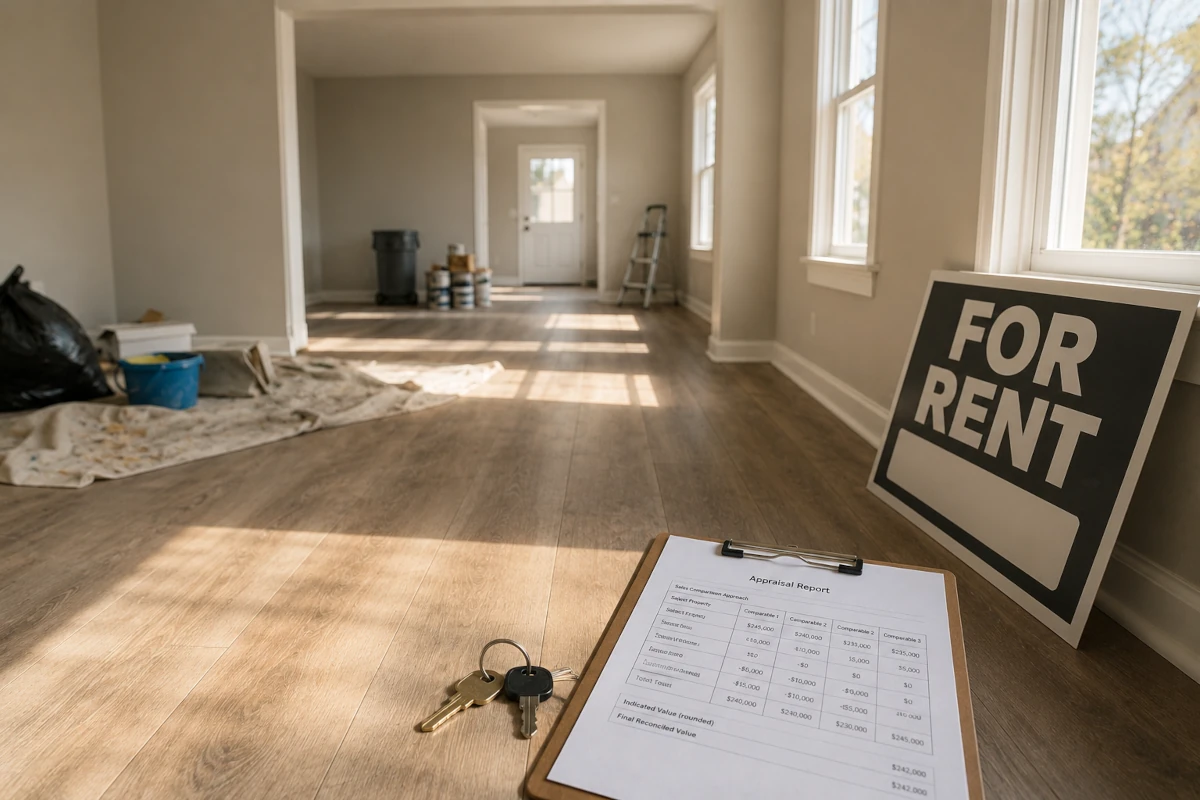
What Is the BRRRR Method
The BRRRR method is a five-step real estate investing strategy: Buy, Rehab, Rent, Refinance, Repeat. You purchase a distressed property below market value, renovate it, place a tenant, then refinance into a long-term loan that pulls most of your capital back out — freeing those same dollars to buy the next property.
The strategy was popularized by David Greene of BiggerPockets and has since become one of the most-discussed approaches in residential real estate investing. The reason it matters: when executed well, a BRRRR deal leaves you with a cash-flowing rental property and most of your original capital recovered. The same $80,000 that would buy one rental in a traditional buy-and-hold strategy can fund 2–3 BRRRR deals per year, each producing a long-term rental asset.
The catch — and there is one — is that BRRRR demands the math work on both ends of the deal: the rehab side (acquiring and renovating below ARV) and the rental side (rents that support the refinance). Getting one right and the other wrong is how most BRRRR attempts stall partway through.
Why BRRRR vs. Buy-and-Hold or Flipping
BRRRR sits between the two more familiar strategies. Understanding the trade-offs helps clarify when it’s the right play and when it isn’t.
BRRRR vs. traditional buy-and-hold rental investing
A traditional buy-and-hold investor buys a rental property at retail or near-retail prices, puts 20–25% down, and holds it for cash flow and appreciation. Capital efficiency is poor — the down payment sits locked in the property for years.
BRRRR investors buy distressed properties below market, force equity through renovation, and refinance to recover their capital. Same end state (a long-term rental), but with the original capital freed up to buy more properties. For investors who want to scale a rental portfolio quickly, BRRRR is meaningfully more capital-efficient than straight buy-and-hold.
BRRRR vs. fix and flip
A flipper sells the renovated property and pays ordinary income tax on the profit. The capital recycles fast (4–6 month cycles), but there’s no long-term asset, no depreciation shelter, and no appreciation participation.
A BRRRR investor keeps the property as a rental. The exit is a refinance, not a sale — which means no taxable event at the “exit,” depreciation shelter on the rental income, and the property continues to appreciate. The trade-off is that capital comes back slower (a refinance recovers 70–80% of the all-in, while a flip sale recovers 100%+ minus selling costs), and you take on the operational complexity of a long-term landlord.
When BRRRR makes the most sense
BRRRR is the right strategy when three conditions line up: (1) the market has distressed inventory available at meaningful discounts, (2) post-rehab rents support a DSCR ratio high enough to qualify for a 75% LTV refinance, and (3) the investor wants to build a long-term rental portfolio rather than book short-term profits. Miss any of those and one of the simpler strategies usually wins.
The Five Steps Explained
Step 1: Buy
The purchase price is where BRRRR succeeds or fails. The deal has to be acquired at a price that, after rehab costs, leaves room for a refinance at 75% of ARV to recover most or all of your capital. Practically, this means buying below market — usually 30–40% below ARV when rehab costs are factored in. Same deal sources as fix-and-flip property: distressed MLS listings, wholesalers, off-market direct outreach, auctions.
Financing the purchase usually means hard money or a bridge loan with a short term (6–12 months) because conventional financing won’t fund distressed properties needing significant rehab. Rates run 10–13% with 2–4 points — expensive, but the financing only has to last through rehab.
Step 2: Rehab
The rehab brings the property to ARV-comparable condition and makes it rent-ready. Scope matters: too little rehab and the appraiser won’t support your target ARV; too much and you’ve over-improved for what the rental market will pay. Match finish level to what comparable rentals in the neighborhood have, not what owner-occupant buyers would expect.
Practical rehab targets for BRRRR: durable flooring (LVP or tile), neutral paint, functional but not luxury kitchens and baths, updated mechanicals if needed for appraisal. Skip the high-end touches that don’t move rent — quartz countertops, custom cabinetry, designer fixtures. Those help a flip; they don’t pay off in BRRRR.
Step 3: Rent
Place a tenant as quickly as possible after rehab completion. Two reasons it matters: every month vacant burns holding costs (financing interest, taxes, insurance), and most lenders require the property to be tenant-occupied before they’ll execute the cash-out refinance.
The rent number matters as much as the tenant. DSCR refinance lenders qualify the loan based on the rent-to-PITIA ratio. A property that doesn’t support DSCR of at least 1.0–1.10 won’t qualify for the 75% LTV refi, which collapses the entire BRRRR math. Run rent comps from Rentometer and verify against comparable rented properties before you commit to the purchase.
Step 4: Refinance
The refinance pulls your capital back out. The standard product is a DSCR cash-out refinance at 75% LTV (some lenders allow 80%; some cap at 70%). The lender appraises the property at its new ARV, lends 75% of that appraisal, pays off the acquisition/rehab loan, and gives you whatever cash is left over. Read the full DSCR loan guide for refinance mechanics →
Most lenders require a seasoning period — typically 6 months from purchase before they’ll execute a cash-out refi at the new appraised value. A handful of lenders offer immediate cash-out with no seasoning, usually at slightly worse terms. Build seasoning into your timeline assumptions.
Step 5: Repeat
Take the recovered capital and find the next deal. The investors who scale BRRRR portfolios fastest treat the loop as a system — they have wholesalers, contractors, property managers, and lenders all ready before they close on each new property. Recovered capital sitting idle between deals is recovered capital that isn’t working.
How to Analyze a BRRRR Deal
The core BRRRR formula calculates the maximum purchase price that lets you recover all your capital on refinance:
Worked example. You’re evaluating a 3-bedroom, 2-bath single-family home in a market where comparable renovated properties sell for $230,000 and rent for $1,950/month. Contractor walks the property and bids $40,000 for the rehab.
| ARV (closed-comp supported) | $230,000 |
| ARV × 75% (refinance loan amount) | $172,500 |
| − Estimated Rehab Cost | $40,000 |
| − Closing on Purchase + Refi (est.) | $8,000 |
| − Holding Costs (6 months @ $700) | $4,200 |
| Maximum BRRRR Purchase Price | $120,300 |
That’s your purchase ceiling. Pay $120,000 or less and the refinance recovers approximately all of your capital. Now let’s model the post-refinance position assuming you close at $118,000:
| Purchase Price | $118,000 |
| + Rehab | $40,000 |
| + Closing on Purchase | $3,500 |
| + Holding Costs (6 months) | $4,200 |
| Total All-In Cost | $165,700 |
| Refinance Proceeds (75% of $230k ARV) | $172,500 |
| − Refinance Closing Costs | $4,500 |
| Net Cash Recovered | $168,000 |
| Capital Left in Deal | ($2,300) |
A perfect BRRRR — capital fully recovered, with $57,500 of forced equity ($230,000 ARV minus $172,500 new loan) on the property. Now check the rental cash flow at the refinanced numbers:
| Gross Monthly Rent | $1,950 |
| − Vacancy Reserve (6%) | −$117 |
| − Property Management (8%) | −$156 |
| − Maintenance + CapEx Reserve | −$210 |
| Monthly NOI | $1,467 |
| − Monthly Debt Service (PITIA on $172.5k) | −$1,350 |
| Monthly Cash Flow | $117 |
| DSCR Ratio | $1,467 ÷ $1,350 = 1.09x |
A DSCR of 1.09x is at the borderline — just qualifying for the refi but with little buffer. In real BRRRR analysis, you want post-refi DSCR of at least 1.15–1.20x to give yourself room against rent softness, rate movements, or expense surprises. Deals that produce a perfect capital-out result but a weak DSCR are deals that look great on paper and get harder to live with month after month.
Run BRRRR-specific math on any property with our BRRRR loan resource.
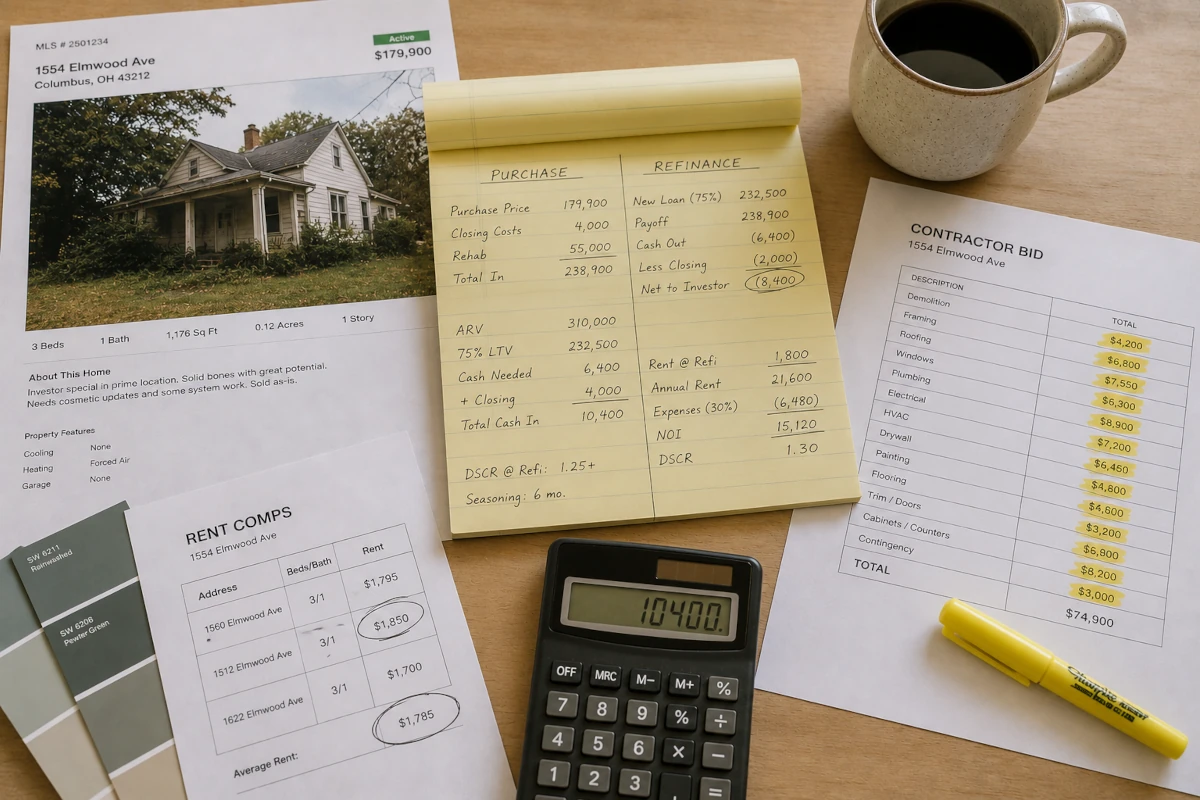
How to Finance Each Stage
BRRRR is the only common real estate strategy that uses two distinct loan products on the same property — one for acquisition + rehab, one for the long-term hold. Sequencing them correctly is part of what makes the strategy work.
Stage 1: Acquisition + rehab financing
Most BRRRR investors use one of three options for the front end:
Hard money loans. The default. Hard money lenders fund distressed properties based on ARV rather than current condition, close in 7–14 days, and structure rehab funds as draws. Typical terms: 10–13% interest, 2–4 points, 6–18 month term. Expensive, but it’s only running for a few months. See full fix & flip loan mechanics →
Bridge loans. Similar structure to hard money but typically cheaper (8–11% interest) and longer-term (12–24 months). Better fit for investors with stronger credit profiles or longer expected rehab timelines.
Cash. If you have it, paying cash gives you the cleanest acquisition (no financing contingency, fast close, no points) and means the refinance can happen on your timeline rather than the acquisition loan’s timeline. Most BRRRR investors who can pay cash still leverage to keep capital deployed.
Stage 2: Refinance into permanent
DSCR cash-out refinance. The standard BRRRR exit. The property qualifies on its rental income (DSCR ratio), not your personal income. Typical refinance terms: 75% LTV, 6–7% rate range in current conditions, 30-year amortization, no DTI calculation. Read the full DSCR guide →
Conventional cash-out refinance. Available to BRRRR investors with strong personal income and DTI capacity. Rates 1–2 points lower than DSCR, but qualification adds layers of personal documentation and won’t scale past your DTI ceiling. Useful for the first 2–3 BRRRR properties; usually replaced with DSCR after that.
Portfolio or commercial refinance. Less common for single SFR BRRRRs. Becomes relevant when investors bundle 4+ properties into a single portfolio loan to simplify management.
The seasoning period
Most cash-out refinance lenders require a seasoning period of 3–6 months from purchase before they’ll lend on the new appraised value (rather than the purchase price). Some lenders offer no-seasoning options at slightly worse terms. Plan for 6 months as the baseline assumption. The seasoning period overlaps with the rehab + lease-up timeline anyway, so it’s less of a constraint than it sounds — but it does mean you’re carrying acquisition financing for a known minimum window.
Common BRRRR Mistakes
The pattern of failed BRRRRs is consistent. The six that wipe out capital:
1. ARV inflation
The most common and most expensive mistake. New BRRRR investors anchor on what they want the property to appraise for, not what closed comps will actually support. When the appraiser comes in 10% below your projected ARV, the refinance loan is 10% smaller — which translates to thousands of dollars of capital stuck in the deal. Pull comps the way an appraiser would: closed sales of similar properties within the past 6 months and a half-mile radius. Active and pending listings don’t count.
2. Underestimating rehab
The corollary of ARV inflation. Get bids from contractors who’ve walked the property, not spreadsheet estimates. Add a 10–15% contingency. Rehabs that run 20% over budget are common; rehabs that run 50% over budget happen often enough that conservative budgeting is mandatory.
3. Buying where rents don’t support DSCR
The price-to-rent ratio that makes BRRRR work is more demanding than for straight buy-and-hold. A property where the math “works on the capital side” (refinance recovers your cash) but produces 0.95x DSCR will be rejected by every reasonable lender. Check rent comps before you check ARV comps.
4. Not running both deal sides at purchase
BRRRR investors who only model the capital-recovery math at purchase time miss the rental performance check. The deal isn’t complete until the refi closes — which means you need the rent number to support the loan that recovers your capital. Run both calculations before you sign the purchase contract.
5. Misjudging the seasoning timeline
Borrowers who assume they can refi 90 days after purchase often discover the lender requires 6 months. The extra 3 months of carrying the acquisition loan adds real cost. Confirm seasoning requirements with your refinance lender before you commit to the acquisition financing.
6. Over-improving for the rental market
Rentals don’t pay back high-end finishes the way flips do. Spending $15,000 on quartz countertops when laminate would have rented for the same price is just deleted equity. Match finish level to comparable rentals in the neighborhood, not to comparable retail sales.
When BRRRR Doesn’t Work
BRRRR is a powerful strategy in the right conditions and a poor one in the wrong conditions. Be honest about whether it fits before you commit capital.
High-priced markets where rents lag values
In coastal metros (most of California, Seattle, NYC, Boston, Miami), property values have outrun rents to the point that a fully-renovated $700,000 property might rent for $3,500/month — nowhere near DSCR-qualifying. BRRRR is structurally hard in these markets because the refinance math collapses on the rental side. Most successful BRRRR portfolios are built in the Midwest, Southeast, or Texas, where price-to-rent ratios still support the strategy.
Properties that won’t appraise
Unusual floorplans, properties with deferred maintenance the rehab didn’t fully address, over-improvements for the neighborhood, and properties in declining areas all create appraisal risk. If the appraiser comes in below your projected ARV, the refinance shrinks proportionally. Choose properties where comparable closed sales are clear and consistent.
Investors who can’t tolerate operational complexity
BRRRR demands managing multiple workstreams: contractor oversight, lease-up, lender coordination, refinance timing. Investors who want a passive experience are better served by buying a turnkey rental property at a slight premium — less profit potential, but vastly less operational load.
Tight cash positions
You still need carrying capital during the 6-month seasoning period. Even with hard money funding the acquisition and rehab, you’re paying interest, taxes, and insurance every month before the refinance recovers your cash. Investors with no reserves often run out of runway mid-deal.
Frequently Asked Questions
For a hard-money-financed BRRRR on a $120,000 purchase with $40,000 rehab, plan on $50,000–$75,000 in cash to close and carry: 10–20% down on the acquisition, points and closing costs, the first rehab draw before reimbursement, and 6 months of holding costs through the seasoning period. Most of that capital is recovered at refinance.
The seasoning period is the time most lenders require between purchase and a cash-out refinance at the new appraised value. Standard seasoning is 6 months, though some lenders offer 3-month seasoning and a handful allow immediate cash-out. Plan for 6 months as the baseline.
Yes, with selectivity. Higher DSCR refinance rates have compressed post-refi cash flow, so the strategy now demands tighter purchase pricing and better rent-to-value markets. Markets in the Midwest and Southeast with strong rental demand and reasonable price-to-rent ratios still produce successful BRRRRs. Coastal high-price markets generally don’t.
6–9 months from purchase to refinance close is the typical target: 2–3 months for rehab, 1 month for lease-up, the remainder for the seasoning period and refinance underwriting. Some experienced BRRRR investors compress this to 4–5 months by using no-seasoning lenders.
Different objectives. Flipping produces faster cash and ordinary income tax treatment; BRRRR produces slower capital recovery but a long-term rental asset, depreciation shelter, and appreciation participation. Investors building a rental portfolio favor BRRRR; investors prioritizing near-term cash favor flipping. Many do both depending on the specific deal.
Not for the first deal, usually. Most investors buy in personal name with the first 1–2 BRRRRs, then move subsequent properties into an LLC for liability separation. DSCR refinance lenders typically allow LLC ownership; conventional lenders generally do not without refinancing out. Consult a CPA and attorney before structuring — this isn’t legal or tax advice.
Get Funded
Finance Your Short-Term Rental
DSCR financing that qualifies on projected STR income — built for Airbnb and vacation-rental investors.
Check Your EligibilityFunding in as little as 7 days · No impact to your credit score