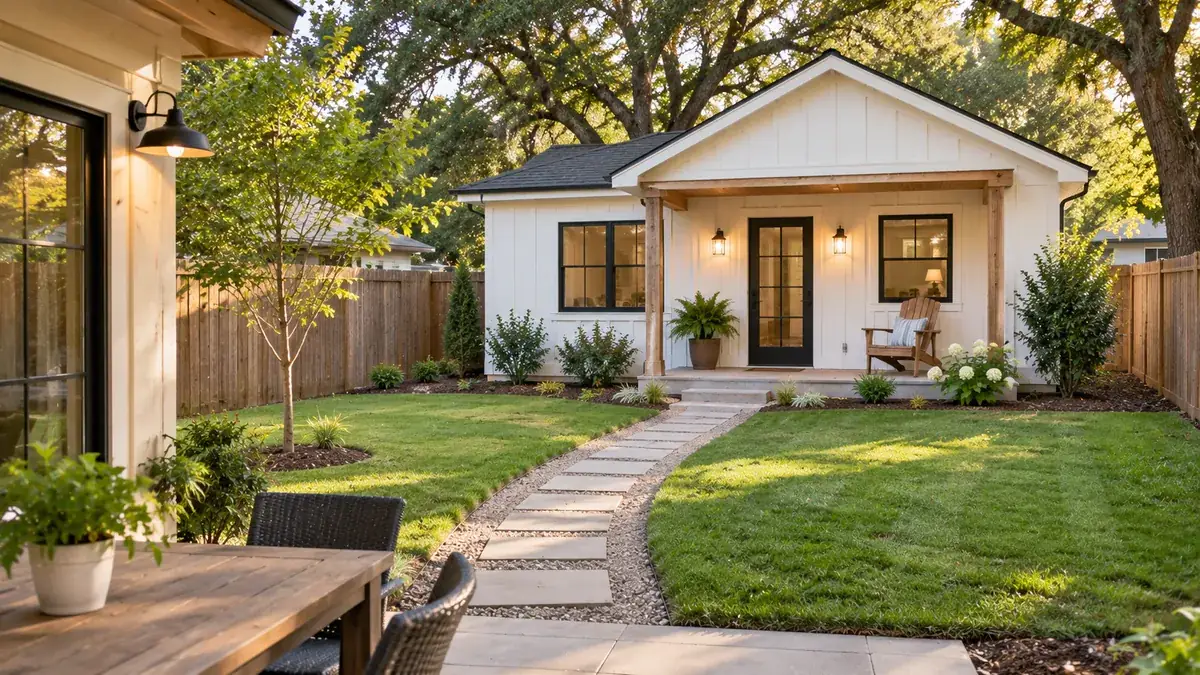
An accessory dwelling unit, or ADU, is a smaller second home on the same lot as a main house. For investors, an ADU can turn one rental into two incomes without buying more land. Many states and cities have also loosened their ADU rules in recent years, which has made these projects more practical in more places.
An ADU is a small construction project, but it's still construction: plans, permits, utilities, and a budget that has to hold. This guide covers the main ADU types, the zoning questions to answer first, how investors finance the build, and how the finished property is valued.
| Type | What it is | Considerations |
|---|---|---|
| Detached | A separate small house in the yard | Most privacy and rent potential; most site work and utility runs |
| Attached | An addition connected to the main house | Shares a wall and sometimes utilities; affects the main house's layout |
| Garage conversion | An existing garage turned into a living unit | Uses an existing structure; may need foundation, insulation, and egress upgrades |
| Interior or junior unit | Space inside the main house converted to a unit | Lowest cost; smaller unit and rules vary more by location |
Before you price a build, confirm the lot can take an ADU. Rules vary widely by state and city. Common questions include:
The local planning department is the best source. Our permits and entitlements roadmap walks through the approval process.
Investors commonly finance an ADU with a construction or renovation loan secured by the whole property. The lender looks at the existing value, the build budget, and the projected value after completion. Funds are usually released in draws as work is inspected, just like a larger build. See construction loan draws explained.
If the property already has a mortgage, the new loan may need to pay it off or sit behind it, depending on the lender and structure. Your existing equity can count toward the equity the lender requires, similar to using land you already own.
Some investors pull equity out of the property first, then pay for the ADU in cash. That's simpler during construction but means paying for the build before it adds value. See DSCR cash-out refinance.
Investors with enough liquidity sometimes build with cash and refinance the whole property afterward, using the higher completed value.
Terms, leverage, and requirements vary by lender for each approach.
An appraiser typically values the whole property with the ADU, not the ADU on its own. For investment property, rental income is part of the picture alongside comparable sales. In areas where few sold properties have ADUs, finding good comparables can be harder, and the value added may come in lower than the build cost. Look for local sales with ADUs before you commit, and be conservative in your projections.
An ADU can add a second rent stream to a property you already own. Start with zoning and permits, then finance the build with a construction or renovation loan, a cash-out refinance, or cash followed by a refinance. Budget fully for site work, utilities, and fees, and be conservative about the value the ADU adds.
Get Funded
Construction financing structured around your draw schedule — line up the build before you close.
Check Your EligibilityFunding in as little as 7 days · No impact to your credit score
Yes. Investors commonly use construction or renovation financing to build ADUs on investment properties. The loan is usually secured by the whole property, and terms depend on the lender, the existing equity, and the project.
Yes. ADUs generally need zoning approval and building permits. Rules on size, setbacks, parking, utilities, and owner-occupancy vary by state and city, so check local requirements first.
Appraisers typically value the whole property with the ADU, using comparable sales and, for investment property, rental income. Where few comparable sales with ADUs exist, valuation can be harder.
Often, yes. After completion, investors may refinance the whole property into long-term financing such as a DSCR loan. Whether the ADU's rent counts toward qualifying varies by lender and local rules.