Short-Term Rentals
The Short-Term Rental Tech Stack: Smart Locks, Noise Monitors, and the Tools Behind a Hands-Off Airbnb
The investors who treat short-term rentals as a side hustle answer guest messages from their phones at 11 p.m., drive to the property to let in lockouts, and learn about parties from neighbors the next morning. The investors who treat short-term rentals as a system have stacks of software and hardware that handle most of those moments before they reach a human. The tech stack is what separates one unit from ten, and ten from owning a portfolio.
This guide walks through the operator-side tech that actually moves the needle — what each category does, where it's worth spending, and how the pieces fit together. We're focused on tools that protect your asset and your time. For guest-facing amenities (the items inside the unit that drive bookings and reviews), see our guide on STR amenities that actually drive bookings.
Most STR operators end up with tools across five categories. You don't need all five on day one — but most professionalizing operators add them in roughly this order:
| Category | What It Solves | When to Add |
|---|---|---|
| Smart lock | Self check-in, no key handoffs, no rekeying after turnover | Property #1 |
| Noise monitor | Catches parties before neighbors call | Property #1 in urban/suburban |
| Dynamic pricing tool | Adjusts rates daily based on demand | Property #1 |
| Property management system (PMS) | Unified inbox, calendar, automated messaging | Property #2 or #3 |
| Channel manager | Syncs listings across Airbnb, Vrbo, Booking.com | When listing on 2+ platforms |
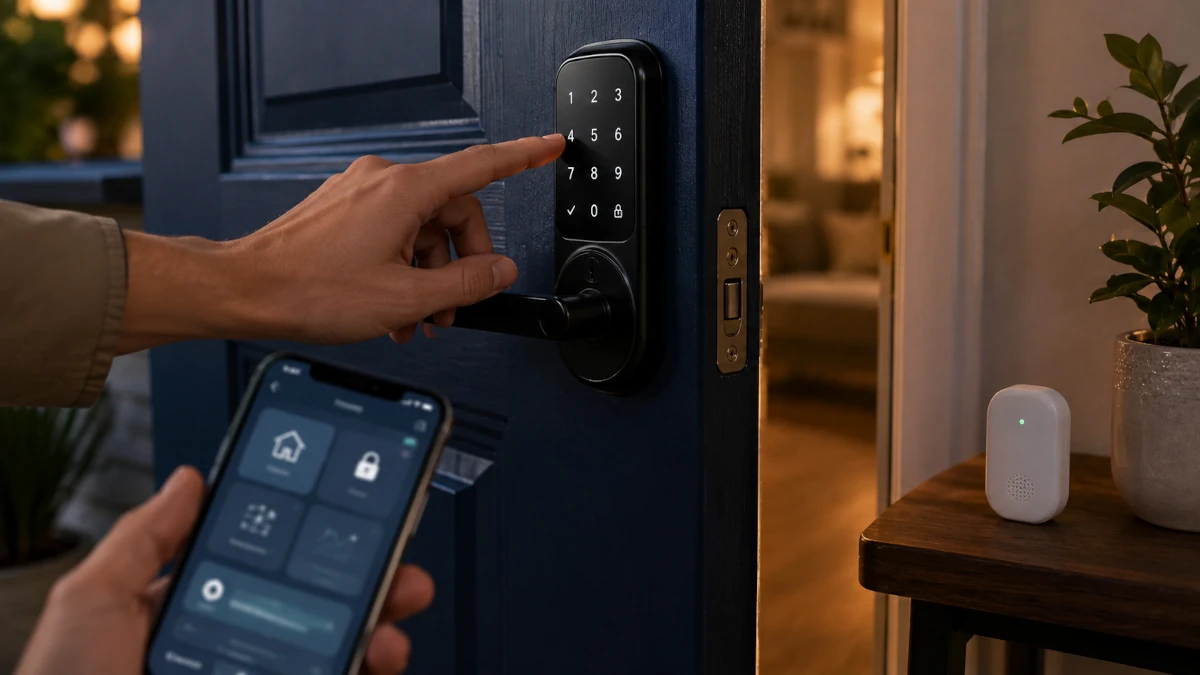
A smart lock is the highest-leverage purchase in the entire stack. It converts every guest arrival from a coordinated key handoff into a self-service moment, eliminates the rekey-or-collect-keys problem at turnover, and creates an audit trail of every entry. Pick one with these properties:
The market leaders for STR are Schlage Encode, Yale Assure, and August. Brand matters less than the integration — whichever lock plays nicely with your PMS or with Airbnb directly is the right one for your stack.
One party at one property can end a short-term rental business in some markets. Neighbor complaints trigger code enforcement; code enforcement triggers permit revocation; permit revocation ends the unit. Noise monitors exist to stop that chain at the first link.
A noise monitor sits on a counter or wall inside the unit, measures decibel levels over time (not audio content — these are privacy-preserving devices), and alerts you when levels exceed your threshold for a sustained period. The good ones don't just alert — they message the guest directly: "We've detected elevated noise at the property. Please be mindful of neighbors." Most disturbances stop right there.
What noise monitors do NOT do: They do not record audio. They cannot distinguish a vacuum from a party. They do not tell you what's being said. They report sound levels — period. Marketing them as audio recording devices to guests is both inaccurate and legally fraught.
The two dominant brands are Minut and NoiseAware. Both run roughly $100–$200 per unit plus monthly monitoring. In urban or HOA-sensitive markets, this is non-negotiable equipment.
Setting nightly rates manually means leaving money on the table on high-demand nights and pricing yourself empty on low-demand nights. Dynamic pricing tools pull demand signals — comparable bookings, local events, day-of-week patterns, lead time — and adjust your rate daily across the entire calendar.
The three players most operators choose between are PriceLabs, Wheelhouse, and Beyond. They run roughly $20–$50/month per unit and typically pay back the cost in the first week. We cover the underlying math (RevPAR, dynamic minimum stays, gap-night discounting) in detail in our STR pricing strategy guide.
The key thing to understand: these tools give you recommendations, not commands. You can override any night, set floor and ceiling prices, and adjust seasonality curves. The good operators tune the tool's strategy quarterly, then let it run.
One Airbnb unit doesn't need a PMS — the Airbnb app is the PMS. Two units across two platforms starts to get awkward. Three units across two platforms with cleaning teams and pricing tools and noise monitors is a chaos you can't manage from a phone.
A property management system unifies:
The mid-market favorites are Hostaway, Guesty for Hosts (Hosttools), OwnerRez, and Hospitable (formerly Smartbnb). Pricing usually scales per property, $20–$60/month per unit. Most include automated messaging that, once configured, eliminates 80–90% of routine guest communication.
Airbnb dominates short-term rental booking volume in most U.S. markets — but not all of it. Vrbo skews family/group, Booking.com pulls international, direct-booking sites capture repeat guests at lower fees. A property listed only on Airbnb is exposed to a single platform's algorithm changes, fee adjustments, and policy decisions.
The channel manager piece of your stack (often built into the PMS) syncs the same listing — calendar, pricing, content — across multiple platforms simultaneously. Book on Vrbo, the Airbnb calendar blocks within minutes. Update one description, all platforms update. Most operators see a 10–20% revenue lift from multi-platform listing once direct bookings start contributing.
| Property #1, Day 1 | Smart lock + Dynamic pricing |
| Property #1, Month 2 | Noise monitor (if urban/suburban) |
| Property #2 | Cleaning team scheduling tool |
| Property #3 | PMS with automated messaging |
| Property #4 | Channel manager + multi-platform listing |
| Property #5+ | Direct booking site, owner accounting |
The biggest source of operator pain is tools that don't talk to each other. A smart lock that requires manual code entry every booking, a noise monitor that doesn't connect to your messaging system, a pricing tool that doesn't push rates to all platforms — every disconnected tool means another manual step in your workflow.
Before buying anything beyond property #1, audit your existing tools and pick replacements that integrate. The hours saved by integration usually exceed any per-feature advantage of a non-integrated tool.
A well-equipped single unit runs roughly $50–$100/month in software and monitoring fees once everything is configured. A 10-unit portfolio runs $300–$700/month total. The math against a single avoided lockout, party complaint, or empty weekend almost always wins.
The short-term rental tech stack isn't optional once you scale past one property — it's the operating leverage that lets one person manage what used to take a small team. Start with a smart lock and dynamic pricing on property #1, add a noise monitor in any noise-sensitive market, and let the PMS arrive when manual messaging starts to break. For the guest-facing side of operations (cleanings, reviews, turnover), see our deep-dive on running same-day turnovers.
Get Funded
DSCR financing that qualifies on projected STR income — built for Airbnb and vacation-rental investors.
Check Your EligibilityFunding in as little as 7 days · No impact to your credit score
Effectively, yes. Self check-in is now the guest expectation in most markets, and rekeying or coordinating physical key handoffs at every turnover wastes hours of your time and your cleaning team's time each week. A Wi-Fi smart lock with per-guest codes that auto-generate from your booking platform is the highest-leverage single purchase in the entire STR tech stack.
No. Reputable noise monitors (Minut, NoiseAware) measure decibel levels over time only — they do not capture or record audio content. They're designed to be privacy-preserving for exactly this reason. They alert you when sound levels exceed your threshold for a sustained period, allowing you to message the guest before a disturbance escalates to neighbor complaints.
Most dynamic pricing tools run $20–$50 per month per property. For an STR averaging $150+ per night, the tool typically pays for itself in the first week by capturing higher rates on a single high-demand weekend. The lift over manual pricing varies but commonly ranges from 10–25% on annual revenue, particularly in markets with seasonality, event-driven demand, or weekday/weekend variance.
Most operators upgrade between property #2 and property #3, or when they begin listing across multiple platforms. The Airbnb app handles a single unit on a single platform well. Once you're managing multiple calendars, multiple platforms, or coordinating cleaning teams across properties, a PMS like Hostaway, Hospitable, or OwnerRez pays back its cost in saved hours within the first month.