Short-Term Rentals
STR Amenities That Actually Drive Bookings: What's Worth the Spend (and What's Not)
New STR operators tend to make one of two amenity mistakes. The first is over-furnishing — spending $40,000 on a high-end finish that only marginally lifts ADR. The second is under-furnishing — saving $8,000 on the wrong line items and losing 30 percentage points of occupancy because the listing reads as bare-bones. The right approach treats amenities as capital investments with measurable returns: which ones move occupancy and ADR enough to pay back their cost, and which look great in photos but produce zero booking lift.
Here is the priority order based on what currently moves the numbers in 2026 STR markets.
These are the items where their presence or absence directly determines whether a guest filters past your listing. Missing any of these will cut your visibility to a fraction of available bookings.
The single most important amenity in the post-pandemic market. Remote workers, long-stay guests, and family vacationers all expect business-grade internet. Listings without explicit Wi-Fi speed advertised, or with documented issues, score lower in Airbnb's search algorithm.
Cost: $80–$150/month operating expense, optional $300–$600 mesh router setup. Booking lift: 5–15% occupancy improvement vs. properties with slow or unreliable Wi-Fi.
A real desk, an ergonomic chair, a monitor port, and good lighting. Not a coffee table with a power strip. Listings with a true workspace photo near the top of the listing perform meaningfully better in business-travel-heavy markets and now also in vacation markets where digital-nomad stays have become normal.
Cost: $400–$1,200 per workspace. Booking lift: 8–20% occupancy in markets with strong work-travel demand; minimal in pure vacation markets.
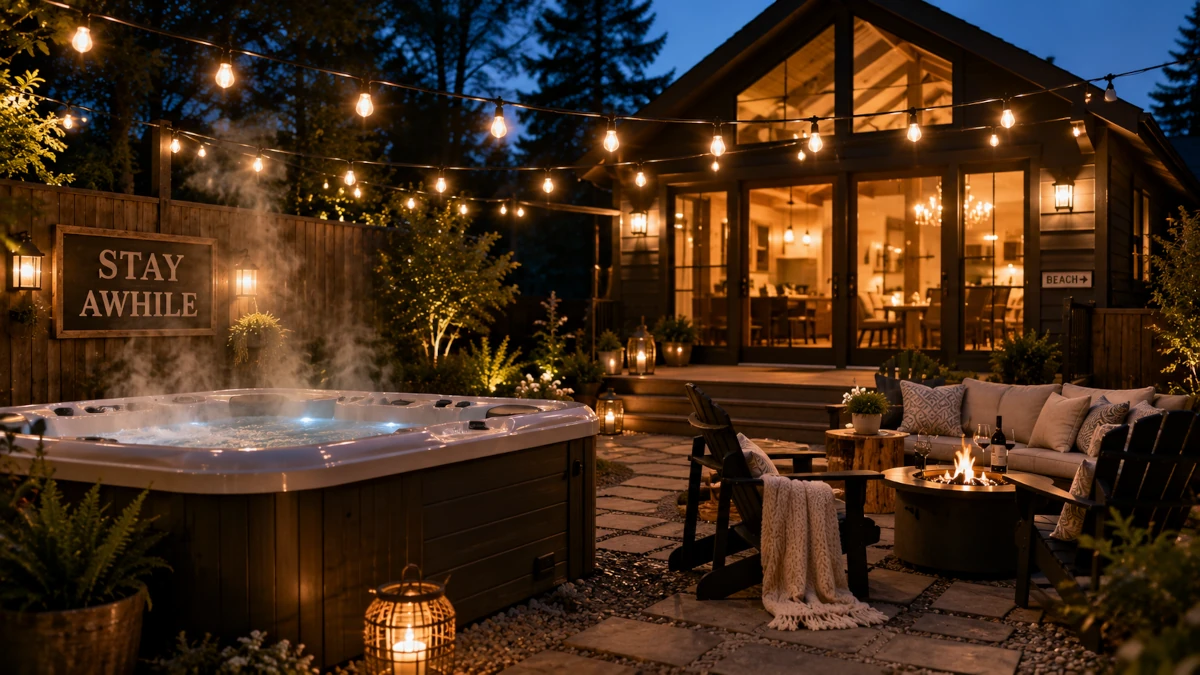
The single highest-ROI amenity in mountain, lake, beach, and rural vacation markets. STRs with hot tubs charge $40–$80 more per night and book at 10–25 percentage points higher occupancy than equivalent non-hot-tub properties in the same area.
Cost: $4,500–$12,000 install + $80–$150/month operating. Booking lift: Often pays back in 8–14 months in vacation markets. Minimal lift in urban or business-travel markets where the addressable demand is different.
A Level 2 EV charger has shifted from a luxury amenity to a near-requirement in many West Coast and Northeast markets and is rapidly becoming so elsewhere. Tesla guests will filter for properties with charging available.
Cost: $800–$2,500 install plus electrical upgrades if needed. Booking lift: 3–8% in markets with high EV penetration; rising. Future-proofs the listing.
These do not block bookings, but they move nightly rate and review scores when added.
Family travel is sticky — once a family books a kid-friendly STR they often rebook the same property year after year. Crib, high chair, and a small drawer of kid plates and silverware open the listing to family search filters.
Cost: $200–$500. Booking lift: Opens an entirely new segment in family-vacation markets. Often pays back in 1–2 family stays.
A real outdoor dining table for 6+, comfortable conversation seating, and ambient lighting (string lights or pathway lighting) transforms how a property photographs and reviews. Buyers psychologically value usable outdoor square footage at near-1:1 with indoor for vacation rentals.
Cost: $1,500–$5,000 for a quality setup. Booking lift: 5–12% ADR uplift; meaningful boost to listing photography quality.
Smart locks reduce friction, eliminate key handoff failures, and improve security. They also unlock late-night arrival markets that hosts who only do meet-and-greet check-ins lose entirely.
Cost: $150–$400 per door. Booking lift: 3–6% incremental bookings (late check-ins); large operational time savings.
Dog-friendly properties charge $15–$50 pet fees per booking and capture a meaningful segment that filters specifically for pet-friendly listings. The actual amenity setup is modest: a dog bowl, a couple of towels for muddy paws, a small fenced area or leash hook outside.
Cost: $200–$1,000 (or $3,000–$8,000 if installing a fence). Booking lift: 8–20% increase in available demand. Higher cleaning costs partially offset.
These improve listing presentation and review tone but do not by themselves move bookings or ADR much. Worth doing when budget allows; not the first dollars to spend.
These often get over-prioritized by new operators because they are visible and feel impressive. The data does not support the spend on most properties.
A clean, functional kitchen with new appliances, decent counters, and matched dishes performs equivalently to a $30,000 designer kitchen on the same nightly rate. Spend on appliances, dishes, and basic upgrades. Do not spend on quartz waterfall counters.
Vacation-market guests notice clean and functional. They do not pay $80 more per night for upgraded shower tile. Spend the budget elsewhere unless the existing bathroom is genuinely below baseline.
These can move ADR in specific niche markets (Bend, Joshua Tree, certain mountain towns) where wellness-positioned listings exist as a category. Outside those niches, the payback math rarely works. A $25,000 cold plunge in a generic suburb produces about $300/year of incremental revenue.
Themed bedrooms (Star Wars, jungle, princess) get strong response on social media and weak response in booking conversion. Most guests want clean, modern, neutral spaces they can imagine themselves in. Theme rooms work for specific market positionings only.
For a typical new STR with a $15,000–$25,000 furnishing budget, here is a defensible spend order:
| Furniture, beds, dishes, towels (baseline functional) | $10,000–$14,000 |
| Workspace + fast Wi-Fi setup | $800–$1,500 |
| Smart lock + smoke/CO detectors | $300–$600 |
| Outdoor seating + lighting | $1,500–$3,000 |
| Hot tub (vacation markets only) | $5,000–$10,000 |
| Pet-friendly setup (if positioning) | $300–$800 |
| Family-travel setup (if positioning) | $200–$500 |
| Recommended initial total (vacation market) | $18,000–$30,000 |
For urban or business-travel markets, drop the hot tub line and reallocate to workspace quality and home office amenities.
Once you have been operating for 6–12 months, you can pressure-test each major amenity with simple A/B logic:
This is the operational discipline that separates investors treating STR as an asset class from operators treating it as a hobby. Every dollar spent on amenities is capital that could be in another deal or in the next property. The amenities with documented payback go in. The ones without it do not.
Fast Wi-Fi, a real workspace, and (in vacation markets) a hot tub are the highest-ROI amenity dollars you can spend. Smart locks, outdoor living space, and pet/family setups are tier-two priorities with strong measured payback. Themed decor, designer kitchens, and wellness installations rarely pay back outside niche positionings. Spend like an underwriter: model the expected ADR and occupancy lift, compare to the amortized cost, and skip the ones where the math does not work even with optimistic assumptions.
Get Funded
DSCR financing that qualifies on projected STR income — built for Airbnb and vacation-rental investors.
Check Your EligibilityFunding in as little as 7 days · No impact to your credit score