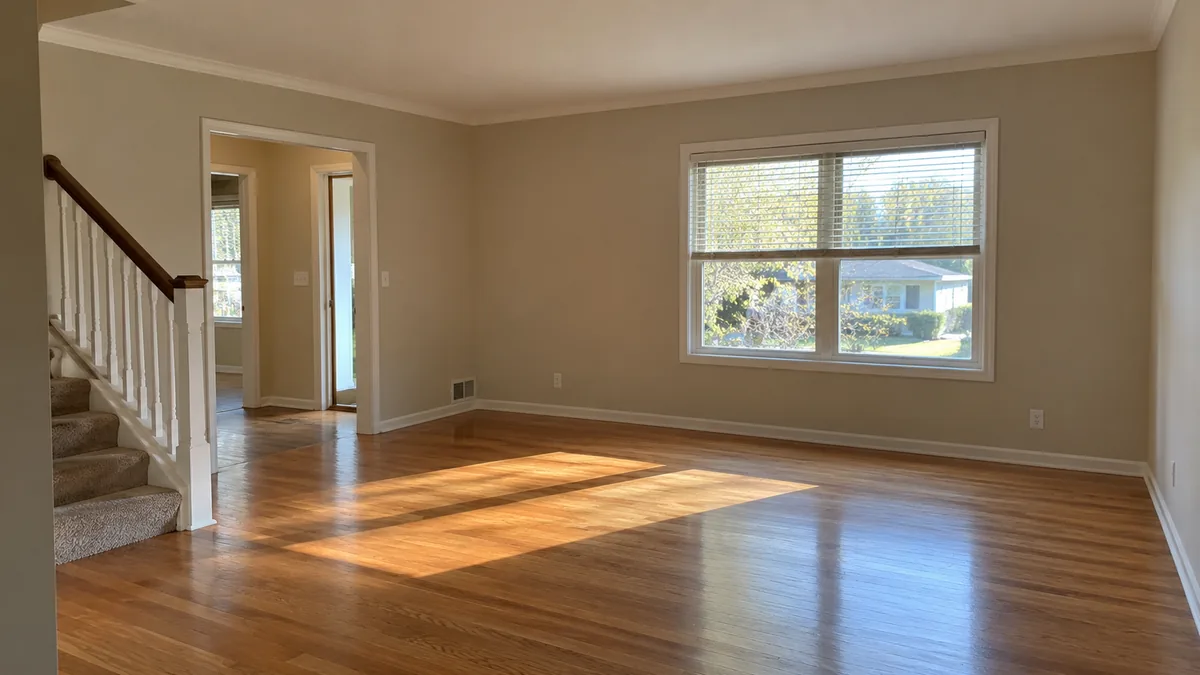
Most rental purchases close with the property empty. The seller moves out, the tenant leaves, or the last lease simply ran out. That raises an obvious question for anyone using a DSCR loan: if the program qualifies on rental income, how does it work when there's no rent coming in yet?
The short answer is that lenders don't need a signed lease to underwrite most DSCR loans. They need a reliable estimate of what the property should rent for. Where vacancy starts to matter is on refinances, on properties that need work, and on files where the estimated rent barely covers the payment.
When there's no lease, the qualifying rent usually comes from the appraisal. Alongside the value, the appraiser completes a rent schedule, typically Fannie Mae Form 1007 for a single-family home or Form 1025 for a 2–4 unit property. It estimates market rent from comparable rentals nearby.
That market rent becomes the top half of the DSCR calculation:
Because the appraiser sets the number, your own rent estimate doesn't drive the loan. If you expect $2,600 a month but the comparables support $2,350, the loan is sized on $2,350. Our guide to DSCR appraisals and Form 1007 explains how appraisers choose comparables and what to do when the rent comes in low.
On a purchase, an empty property is normal and expected. Many DSCR programs simply use the appraiser's market rent for a vacant home. Some will use the lower of market rent and an existing lease if one is in place. Either way, a vacant purchase isn't a red flag by itself.
Refinances are where programs differ the most. You've owned the property for a while, so a lender may reasonably ask why it isn't rented. Depending on the program, a vacant or unleased refinance might see one or more of the following:
Not every program applies these rules, which is why comparing options matters more on a vacant refinance than on almost any other DSCR file.
Here's a simple illustration of why a reduced rent figure matters. The numbers are hypothetical, and the actual adjustment, if any, depends on the program:
| Appraised market rent | $2,400 / month |
| Monthly PITIA | $2,000 |
| DSCR at full market rent | 1.20 |
| Rent counted at 90% (vacant refinance example) | $2,160 / month |
| DSCR after the reduction | 1.08 |
A file that looked comfortable at 1.20 is now close to the 1.0 line. If the program's minimum is higher, the loan amount may have to come down. If the ratio is still short, some investors look at low-ratio DSCR programs. The simplest fix, though, is usually a signed lease.
Vacancy caused by condition is a different problem. DSCR loans are built for rentable properties. If the appraiser notes repairs that affect safety, soundness, or livability, the appraisal may come back "subject to" those repairs, and the loan can't close until they're done.
For a property that needs real renovation, investors often use a short-term loan first, finish the work, place a tenant, and then refinance into a DSCR loan. That path is covered in fix and flip exit strategies and the BRRRR strategy.
A vacant or unleased property can absolutely qualify for a DSCR loan. On a purchase, lenders generally rely on the appraiser's market rent. On a refinance, expect more questions, and possibly a lease requirement, a rent reduction, or lower leverage. Run the ratio on the appraiser's likely rent, keep a cushion of reserves, and get a tenant in place before refinancing whenever you can.
Get Funded
Qualify on the property's rental income — no tax returns, no W-2s. See your rate and terms in minutes.
Check Your EligibilityFunding in as little as 7 days · No impact to your credit score
Yes. Many DSCR programs qualify a vacant property using the market rent estimated by the appraiser on a rent schedule, such as Form 1007. Vacancy is common on purchases and isn't a problem by itself.
Usually the market rent from the appraisal's rent schedule, which is based on comparable rentals near the property. Your own rent estimate doesn't set the qualifying number.
It depends on the program. Some refinance programs require a signed lease, some count only part of market rent for an unleased property, and some lower the maximum loan-to-value. A lease at or near market rent makes a refinance simpler.
Some DSCR programs allow short-term rental income using third-party revenue projections, but the rules differ from long-term rentals and not every program allows it. Ask about short-term rental eligibility before you apply.