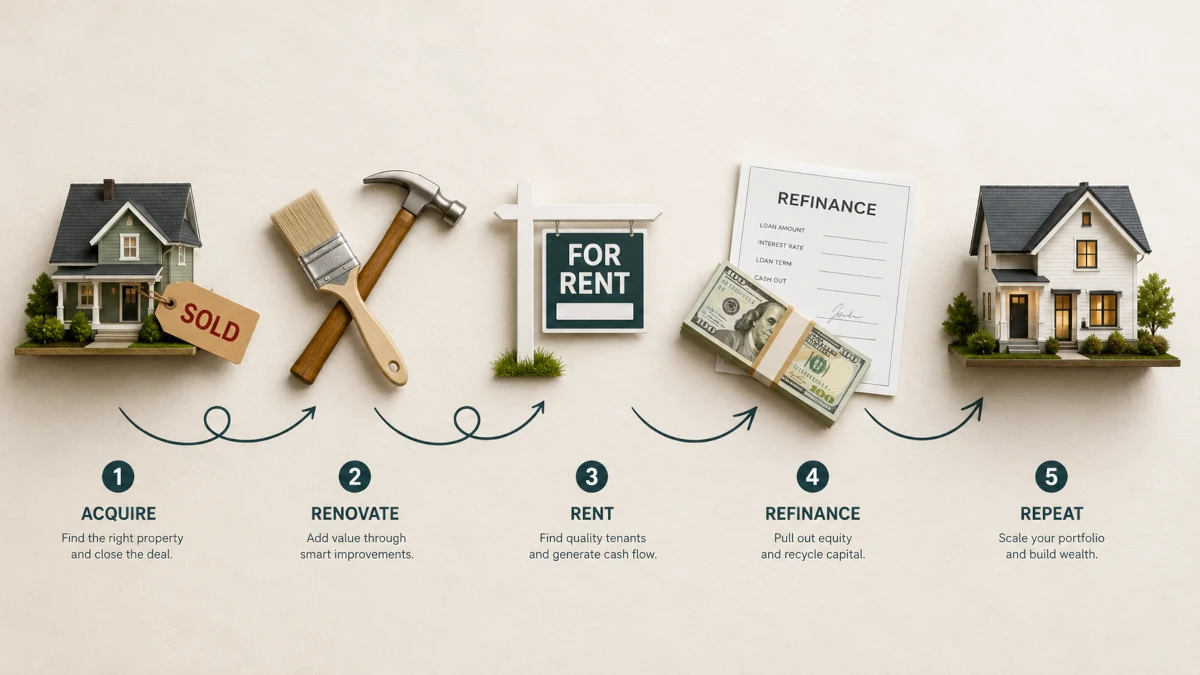
BRRRR — Buy, Rehab, Rent, Refinance, Repeat — is the way many small investors build a rental portfolio without a large initial bankroll. The whole point is to pull most or all of your invested capital back out after stabilization so you can deploy it into the next deal. Done right, the same $80,000 can buy you four or five rentals over a few years. Done wrong, you end up with one over-leveraged property, no cash, and a mortgage payment that wipes out the cash flow.
This guide walks the strategy phase by phase, with the actual math at each step, the underwriting traps that catch first-timers, and a fully worked example.
The first letter of BRRRR is the one most beginners get wrong. You are not buying a turnkey rental. You are buying a distressed or under-improved property at a discount to what it will appraise for after rehab. The acquisition math is closer to a fix-and-flip than to a stabilized rental purchase.
The universal rule used by experienced BRRRR investors is the 75% rule:
| Maximum All-In Cost | 75% of After-Repair Value (ARV) |
| Where All-In = Purchase + Rehab + Holding + Closing | |
| Why 75%? | Standard cash-out refinance LTV cap |
If a stabilized rental will appraise for $260,000 after rehab and the standard cash-out DSCR refinance caps out at 75% LTV, you can refinance up to $195,000. To pull all of your capital back out, your total project cost must come in at or below that number. Pay $160K, spend $30K on rehab, $5K on holding and closing, and you are at $195K all-in — a textbook BRRRR with zero remaining cash invested.
Pay $180K for the same property, spend the same $30K, and your $215K all-in only refinances to $195K. You are leaving $20K stuck in the deal. The acquisition price is where BRRRR is won or lost.
Rehab in a BRRRR deal has one job: deliver the ARV the refinance appraiser will agree with. That means matching the finish level of the comparable sales the appraiser will pull, not exceeding them. Quartz when the comps have laminate is wasted money. Vinyl plank when the comps have hardwood may save money but tank your appraisal.
The scope categories that almost always pay back at appraisal:
Scope categories that rarely pay back in a rental BRRRR: high-end fixtures, custom built-ins, smart home technology, premium appliances, and anything bespoke. Save those for owner-occupants.
The second R is rent, and the timing here matters more than most investors realize. Cash-out refinance lenders almost universally require what is called a "seasoning" period — a window between when you bought the property and when you can refinance based on its appraised value rather than its purchase price. Standard seasoning is six months. Some lenders go to three months; some require twelve.
During that seasoning window, you must place a qualified tenant under a signed lease — ideally a 12-month lease — before the refinance appraisal happens. Why:
Screen carefully. A bad tenant placed during this phase is a multi-year cost that wipes out years of BRRRR equity gains. Our guide to tenant screening fundamentals covers the basics.
The refinance is the moment of truth. Most BRRRR investors today use a DSCR cash-out refinance rather than a conventional loan, because DSCR underwriting uses the property's cash flow rather than the investor's personal income. The 75% LTV cap is the standard ceiling, though a small number of programs go to 80% for very strong credit and DSCR.
The refinance numbers to track:
| Metric | What to Target | What Will Kill the Deal |
|---|---|---|
| Appraised Value | At or above your underwriting ARV | Appraisal $15K+ below ARV |
| LTV Cap | 75% (some programs 80%) | Lender restricts to 70% on cash-out |
| DSCR | 1.20 or higher | DSCR drops below 1.00 after refinance payment |
| Closing Costs | 2–4% of loan amount | Costs eat into your cash-out proceeds |
| Prepayment Penalty | Understand the structure | 3-year hard PPP traps your exit |
For background on PPP structure, see our explainer on how DSCR prepayment penalties actually work.
The final R is what makes BRRRR powerful. Because you pulled your capital back out, you can deploy it again. Investors who do this consistently can build a portfolio of five to ten rentals over three to five years on the same starting capital that would otherwise buy one or two properties.
The mathematical limit is set by two things: how disciplined you are about the 75% rule, and how many simultaneous DSCR loans your lender will give you. Most DSCR programs cap a single investor at 10–20 financed properties depending on credit profile and total loan exposure.
Consider a 3-bedroom, 2-bathroom single-family home in a Midwest secondary market:
| Purchase Price (distressed) | $135,000 |
| Rehab Budget | $38,000 |
| Holding Costs (4 months: insurance, utilities, taxes, interest on hard money) | $6,500 |
| Acquisition Closing Costs | $4,500 |
| Total All-In Cost | $184,000 |
| After-Repair Value (post-rehab appraisal) | $250,000 |
| All-In to ARV Ratio | 73.6% |
| Market Rent (signed lease) | $2,100/mo |
| DSCR Cash-Out Refi at 75% LTV | $187,500 |
| Refinance Closing Costs | $5,500 |
| Net Cash Out to Investor | $182,000 |
| Capital Stuck in Deal | $2,000 |
The investor recovered $182,000 of the $184,000 deployed and now owns a property with a 1.21 DSCR (rent $2,100, new PITIA approximately $1,735). $2,000 is permanently stuck in the deal — a result well within the band most BRRRR practitioners consider successful.
The deals that go wrong almost always fail at one of these four places:
The investor paid $180K on a property with $240K ARV. After rehab and holding the all-in is $220K, which refinances at only $180K — leaving $40K stuck and a worse cash-on-cash return than a turnkey rental would have produced.
A $30K rehab becomes $48K once the contractor opens walls. Suddenly the all-in math no longer pencils. Build a 15–20% contingency into every rehab budget.
The investor underwrote a $260K ARV but the appraisal comes in at $235K. Refinance proceeds drop by nearly $19K. Mitigate this by pulling your own comparable sales before you buy, not after rehab.
The investor finishes rehab in month two and tries to refinance in month three, but their lender requires six months of seasoning. Carrying costs for those extra three months — insurance, taxes, debt service — eat into the project budget.
BRRRR is the wrong strategy when:
BRRRR works. It has built more small-investor portfolios over the last decade than any other strategy. But the version that actually works requires discipline on acquisition price, rehab scope, and refinance math. The 75% rule is not a guideline — it is the entire strategy. Buy at the wrong price and no amount of operational excellence later will save the deal.
Get Funded
Long-term rental financing that qualifies on cash flow — scale your portfolio without the income docs.
Check Your EligibilityFunding in as little as 7 days · No impact to your credit score