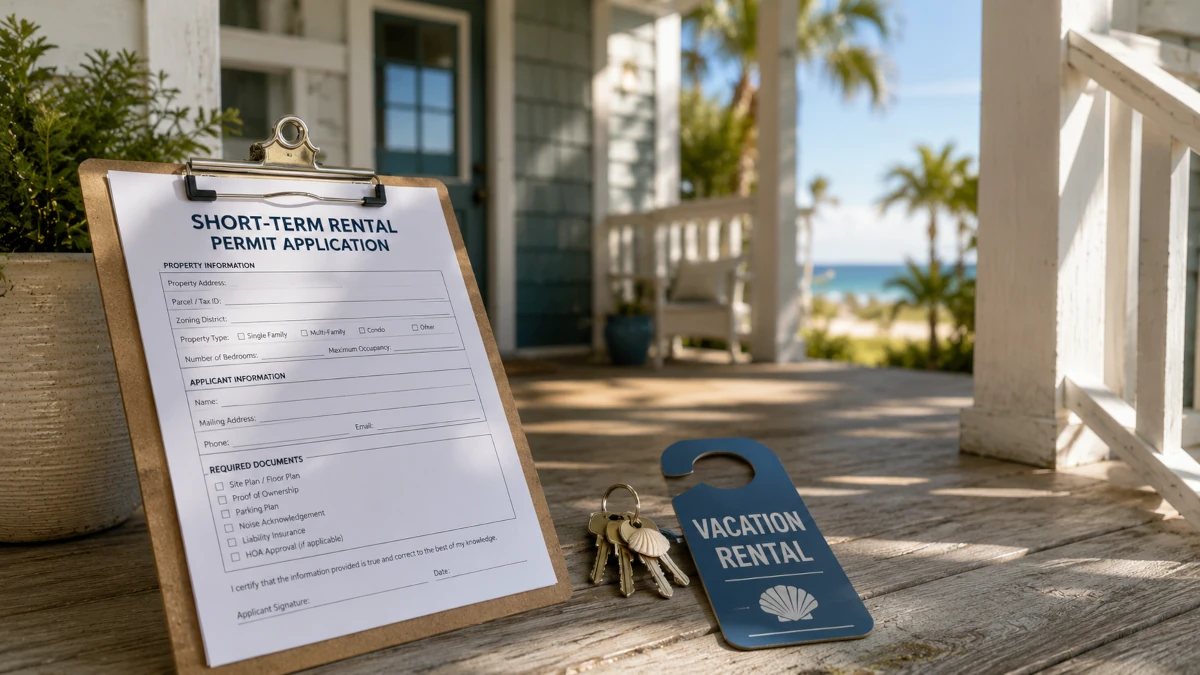
An investor in Austin buys a four-bedroom near downtown in 2019, spends $40K furnishing it, lists it on Airbnb, and clears $90K of net revenue in the first 12 months. Two years later the city tightens enforcement of an existing rule limiting non-owner-occupied STRs and the investor is told to stop operating. The property is now worth less than they paid because no other STR operator can use it either, and the long-term rental yield supports half the carrying cost.
This story plays out somewhere in the US every month. STR regulation is the single largest risk in this asset class, and it is the one most often skipped in pre-purchase diligence because the rules are buried in municipal code, change without warning, and vary not just by city but often by neighborhood or even tax parcel. Here is the framework to do this work before you buy — not after.
STR rules in the US stack at four levels. You need to check all four:
| Layer | What It Governs | Where to Check |
|---|---|---|
| State | Preemption of local rules, occupancy tax collection, mortgage disclosures | State legislature website, state real estate commission |
| County / Parish | Health and safety codes, septic capacity, sometimes occupancy taxes | County clerk, planning department |
| City / Municipality | Zoning, hosting caps, permit requirements, primary-residence rules, density limits | City planning/zoning department, municipal code online |
| HOA / Condo / Subdivision | Private restrictions on rental terms, often 30+ day minimums | CC&Rs, HOA board, recorded covenants |
HOA restrictions are the most commonly missed of these four. A property in a perfectly STR-friendly city can be in an HOA that bans rentals under 30 days — killing the Airbnb strategy entirely. Always read the HOA documents before you write an offer.
STR is treated like any other residential use. No permit, no cap, no neighbor-notification requirement. Examples: many small towns and tourism-friendly counties without zoning teeth. The market upside is large but so is the risk that regulation arrives later. Diligence move: read recent city council minutes for any draft STR ordinances under discussion. The fully permissive market that is studying a new ordinance is the riskiest one to buy in — you might get one good year before rules change.
You must register the property with the city and pay an annual permit fee ($50–$500 typical). Sometimes safety inspections and a local-contact requirement. Once permitted, you operate normally. Examples: many mid-size cities. Diligence move: verify the permit is transferrable to a new owner or that a new owner can obtain one. Some cities have grandfathered existing permits and frozen new issuance.
STRs are permitted only at the host's primary residence. Pure-investment STRs are prohibited or capped to renting out a spare room. This is the model that killed the Austin investor in the opening scenario. Examples: New York City, Los Angeles, San Francisco, many beach communities tightening from prior permissive regimes. Diligence move: if the city has any version of this rule, the property must be off the buying list unless you are a primary-residence house-hacker. Loopholes do not stick around — cities close them.
City has issued a fixed number of STR permits city-wide or by zone. Once the cap is hit, no new permits issued. Existing permits sometimes transferrable, sometimes not. Examples: Hilton Head, parts of Lake Tahoe, several Florida beach towns. Diligence move: confirm whether the existing permit conveys with the property or expires at sale. A property with a transferrable existing permit is materially more valuable than an identical one without — price the difference into your offer.
STR permits limited to a certain density per block or per zip code (e.g., no two STRs within 1,000 feet of each other). Examples: several Texas and California cities, some New England towns. Diligence move: request a map of currently permitted STRs from the planning department and verify your subject property qualifies under the distance rule.
City prohibits short-term rentals entirely, or imposes a 30-day minimum stay that eliminates Airbnb-style operation. Examples: many residential-zoned NYC neighborhoods, parts of LA, an increasing list of California coastal cities. Diligence move: if the minimum stay is 30+ days, the property is a long-term or mid-term rental, not an STR. Some operators pivot to mid-term rentals, which can still work financially but with a fundamentally different revenue model.
Before you write an offer, complete every item on this list. Pay an attorney $300–$800 for an opinion letter if you cannot answer item 1 yourself with full certainty.
The municipal code is only half the picture. The other half is the political momentum — whether local sentiment is moving toward more or less restriction. Three reliable signals:
Once you have confirmed the property can legally operate as an STR, you also have to plan for tax collection and remittance:
The single best protection against regulatory risk is to underwrite every STR purchase to two scenarios: the STR pro forma and the long-term rental pro forma. If the property still cash flows at long-term rents (even if barely), you have built in regulatory insurance. If it only works at STR revenues, you are taking concentrated regulatory risk — and that risk should price into your offer.
A worked example from a typical $500K STR purchase:
| STR pro forma annual net cash flow | $22,000 |
| Long-term rental pro forma annual net cash flow | $2,400 |
| Regulatory delta (at risk) | $19,600/yr |
You can buy this. But if the city tightens regulation in year three, you lose $19,600 of annual cash flow. The right offer price reflects that downside scenario probability-weighted, not just the upside.
STR regulatory diligence takes 8–15 hours per property on the front end and saves operators from outcomes that have wiped out other investors' entire equity. Build a written checklist, complete it before every offer, and underwrite both the STR and long-term rental scenarios. Markets with strong regulatory permanence (clear codes, low political opposition, transferrable permits) deserve premium pricing. Markets where the rules might change deserve discount pricing. Treat the law as a risk variable in the deal, not as a separate concern.
Get Funded
DSCR financing that qualifies on projected STR income — built for Airbnb and vacation-rental investors.
Check Your EligibilityFunding in as little as 7 days · No impact to your credit score