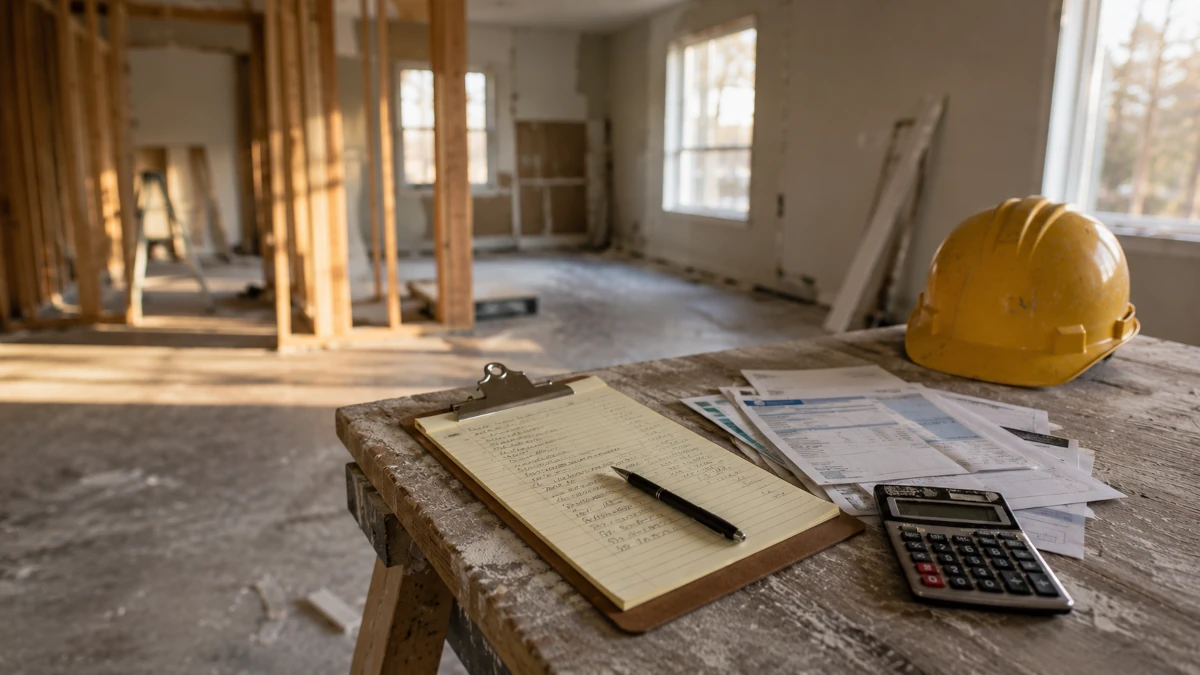
Holding costs are every dollar a property costs you between the day you close on it and the day you sell it — excluding the rehab itself. They are the meter running in the background while crews work, permits get pulled, and listings sit on the market.
Most beginner flippers underwrite the deal as if it were instantaneous. They subtract purchase price and rehab budget from ARV, see a $40,000 spread, and call it profit. The hard truth is that holding costs typically eat 15-30% of that spread on a normal-timeline flip — and 50-100% of it on a delayed one. A flip that pencils at $40K profit on a 4-month timeline can easily produce $8K profit on a 7-month timeline, and a loss at 9 months.
Fix and flip loans typically carry 9-12% interest rates, sometimes higher on smaller loans or first-time flippers. Interest accrues monthly on the entire outstanding balance.
For a $300,000 acquisition + $75,000 rehab loan at 11%, total monthly interest runs about $3,440. Over a 4-month flip that is $13,760. Over a 6-month flip it is $20,640. The difference between a fast flip and a slow one is almost entirely an interest story.
One nuance: most fix and flip lenders fund the rehab in draws against completed work, so interest only accrues on funds that have actually been disbursed. Your effective monthly interest at month 1 may be lower than at month 5 once the full rehab budget has been drawn.
Annual property taxes are prorated across your hold period. For a $400,000 ARV property in a 1.2% tax state, that is $4,800/year, or $400/month. In high-tax markets like New Jersey, parts of Texas, or Illinois (2-3%+ tax rates), the same property could carry $700-1,000/month in taxes during the hold.
Taxes are often paid by the title company at closing as a credit/debit, not by the flipper directly during the hold. But they reduce your net proceeds at sale either way.
You cannot use a homeowner policy on a vacant flip property. The right product is a builder's risk policy or a vacant dwelling policy, both of which price 1.5-3x what a comparable owner-occupied policy costs.
Expect $150-300/month for typical single-family flips, $300-500/month on more expensive properties or in higher-risk geographies. Vacant dwellings in hurricane zones, earthquake zones, or wildfire zones can cost dramatically more.
Skipping insurance to save money is the single most expensive mistake in flipping. A fire, vandalism event, or pre-existing systems failure can cost more than the property itself.
You need power and water during construction, which means utilities stay on. Expect:
Total utility load typically runs $200-400/month on a single-family flip. Higher in larger properties, hot climates with crews running AC, or cold climates needing heat.
If your flip is in an HOA, expect $100-600/month depending on the community. Luxury condos and gated communities can run $800-1,500/month. These are non-negotiable and accumulate every month you hold.
Special assessments are the surprise category — get the HOA's reserve study and recent meeting minutes during due diligence to flag pending special assessments before you close.
Vacant properties in renovation need basic upkeep: lawn care during summer ($100-200/month), snow removal in winter, periodic security checks. In some markets you may want a vacant property monitoring service ($30-100/month) or even temporary security.
For a typical $400K ARV flip with a $300K acquisition + $75K rehab budget, monthly holding costs add up roughly like this:
Monthly burn: ~$4,400. That is your cost of doing nothing for a month — no work, no permit movement, no progress at all. It is also the number that determines whether a flip pencils.
Same flip, two timelines:
Scenario A — 4-month flip:
Wait — even the 4-month version loses money? It does, because the spread between purchase + rehab and ARV was too thin. This is exactly the diagnostic value of running holding costs in the underwrite: deals that look profitable on paper become losses once you load in the real cost of time.
Now the same scenario with proper margin (purchase $260K instead of $300K):
A three-month delay turned a 6.2% profit margin into a 2.7% margin — the same project, just held longer. This is why experienced flippers pay close attention to scope discipline and contractor timelines.
Three rules that separate experienced flippers from beginners:
You cannot eliminate holding costs, but you can compress them:
Holding costs are the silent killer of flip profits. Underwrite them explicitly, model the realistic timeline rather than the optimistic one, and treat every week of slippage as a real budget hit — because it is. The flippers who stay profitable across market cycles are the ones who internalize that time is the most expensive material on the job site.
Get Funded
Fast hard-money and bridge financing built for flips — competitive terms so you can close and start the rehab.
Check Your EligibilityFunding in as little as 7 days · No impact to your credit score